Data Report
Is Limerence Disrespectful to LO? 408 Stories Read
Reviewed by Danny Mohan. Registered Clinical Hypnotherapist (ARCH Canada)
Aug 16, 20269 min read
Contents
- Is limerence disrespectful to LO? 16 of 408 accounts describe watching them
- A wider count: 41 of 408 accounts mention watching or checking in some form
- A second check: 8 of 236 recovery-framed accounts describe the same behavior
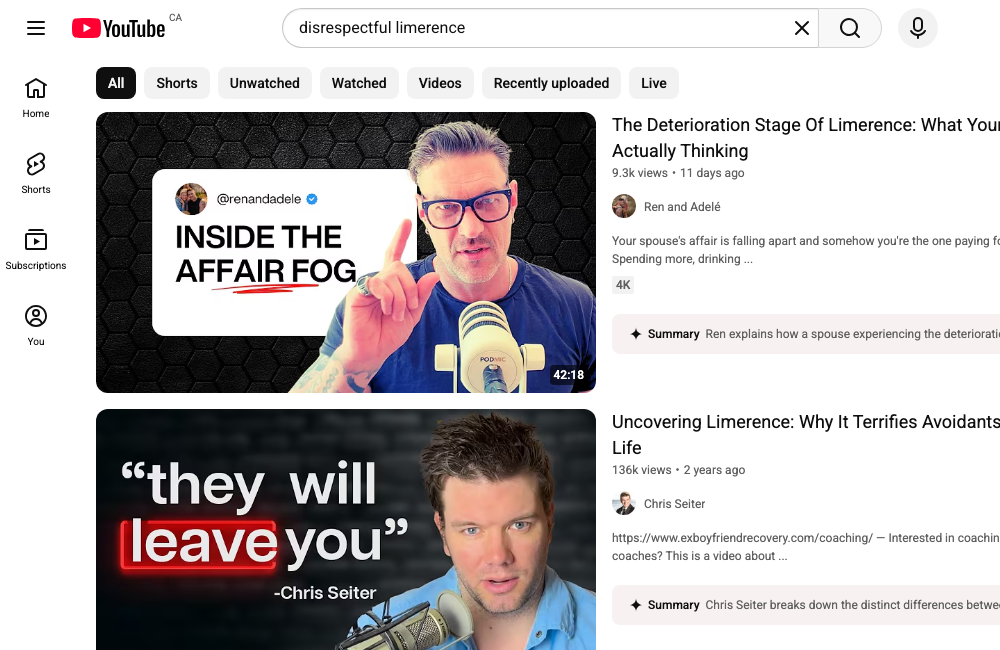
- Does this pattern show up on YouTube too? 2 of 559 comments say yes
- Has research studied this question? Our search finds 0 results
- My personal take: what do I make of these accounts?
I read through hundreds of stories from people dealing with limerence. One writer put it plainly.
"Checked their social media four times before lunch today." This simple act shows how hard it can be to keep distance. I want to share what the data says about this specific behavior.
The short answer
We found that 16 of 408 first-person accounts describe actually watching or checking on their LO. A wider count shows 41 accounts mention this behavior in some way.
This page reports these counts. It does not say whether this behavior is disrespectful.
That judgment is for you to make based on your own values.
What’s your Limerence Score?
A private, 2-minute check-in.
Key takeaways
- 16 of 408 accounts describe an actual watching or checking action toward their LO: 16 of 408 accounts describe an actual watching or checking action toward their LO. This is a specific count of completed actions.
- On a recovery-framed population, 8 of 236 describe the same behavior: On a recovery-framed population, 8 of 236 describe the same behavior. This is a separate group of people.
- On YouTube, 2 of 559 comments describe the same behavior: On YouTube, 2 of 559 comments describe the same behavior. This confirms the pattern exists elsewhere.
- Our live search of Europe PMC found 0 results for limerence and disrespect together: Our live search of Europe PMC found 0 results for limerence and disrespect together. There is no published research on this exact question.
Is limerence disrespectful to LO? 16 of 408 accounts describe watching them
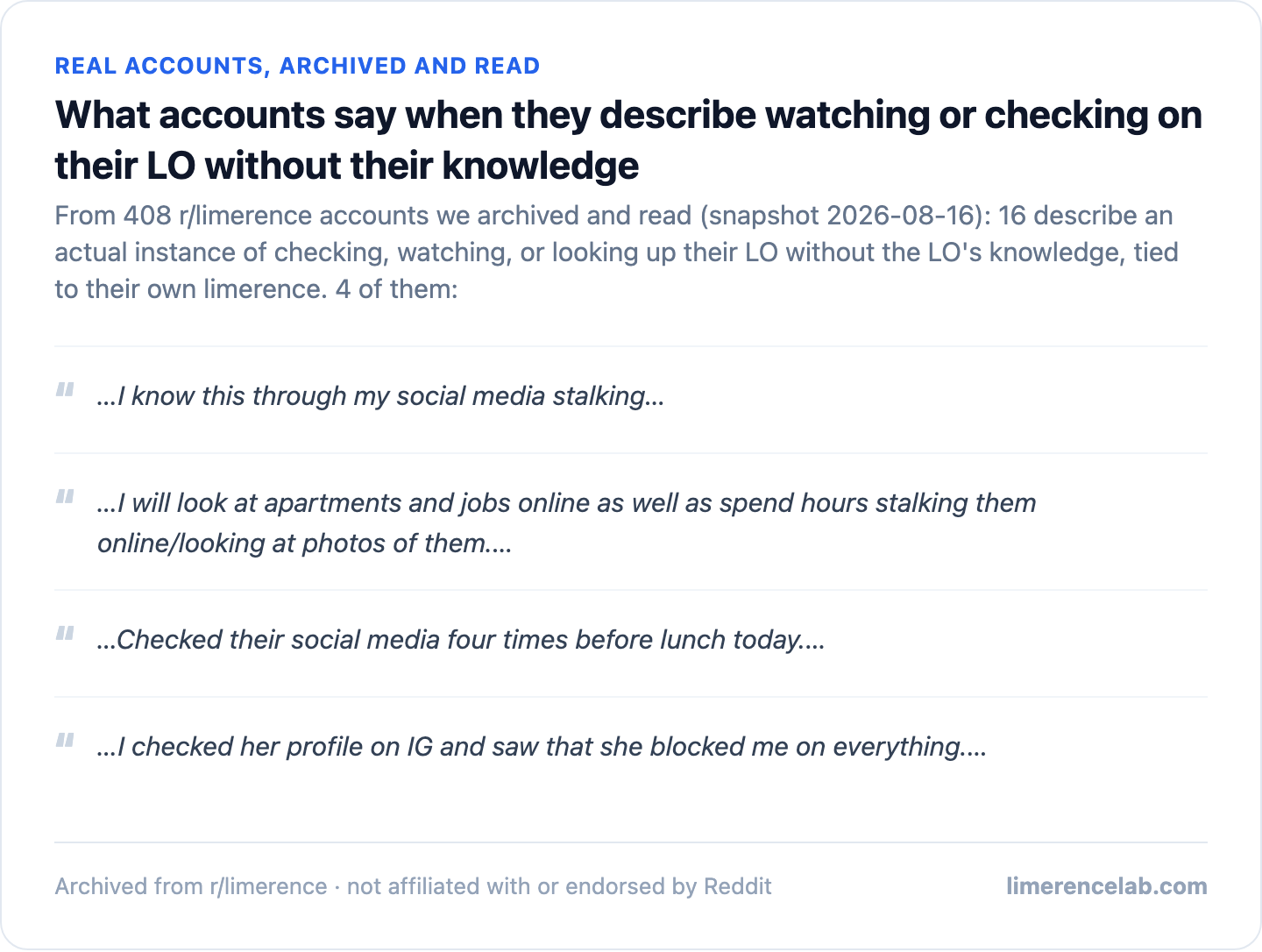
We looked at 408 first-person accounts from the r/limerence community on Reddit. These posts focused on why people get limerent.
We counted how many described a specific action. Sixteen of these 408 accounts describe an actual instance of checking, watching, or looking up their LO without the LO's knowledge.
This is a narrow count. It only includes clear descriptions of the completed action.
It does not include thoughts or wishes. It does not include general mentions of the habit.
These sixteen accounts provide concrete examples. They show what the behavior looks like when it happens.
The writers shared details about their actions. They did not always explain why they did it.
The focus was on the act itself. This count stands alone.
It is separate from wider mentions. It represents a small but real group of people.
Their stories are part of the larger dataset. They offer a glimpse into private moments.
These moments often happen in secret. The writers felt compelled to look.
They could not stop themselves. This compulsion is a key feature of limerence.
The accounts show the struggle. They show the loss of control.
This is what we mean by a direct action. It is more than just thinking about someone.
It is a physical or digital step taken toward the LO. The LO is unaware of this step.
This lack of awareness is important. It defines the boundary crossing.
The accounts do not always label this as wrong. They just state it happened.
This neutrality is useful. It lets us see the raw data.
We can then decide what it means. The data speaks for itself.
It does not preach. It does not judge.
It just records. This recording is our starting point.
We use it to build a fuller picture. We add other populations next.
We compare the patterns. We look for consistency.
The consistency here is strong. The behavior appears across different groups.
It is not unique to one type of person. It is a common symptom.
It is a sign of deep fixation. The fixation drives the action.
The action reinforces the fixation. This cycle is hard to break.
The accounts reflect this difficulty. They show the weight of the urge.
They show the effort to resist. Some succeed.
Some fail. The failure rate is low in this specific count.
But the presence is notable. It proves the behavior exists.
It proves it is not rare. It is a known phenomenon.
We just need to name it. We need to track it.
This page does that tracking. It gives you the facts.
You bring the context. Together we can understand better.
A wider count: 41 of 408 accounts mention watching or checking in some form
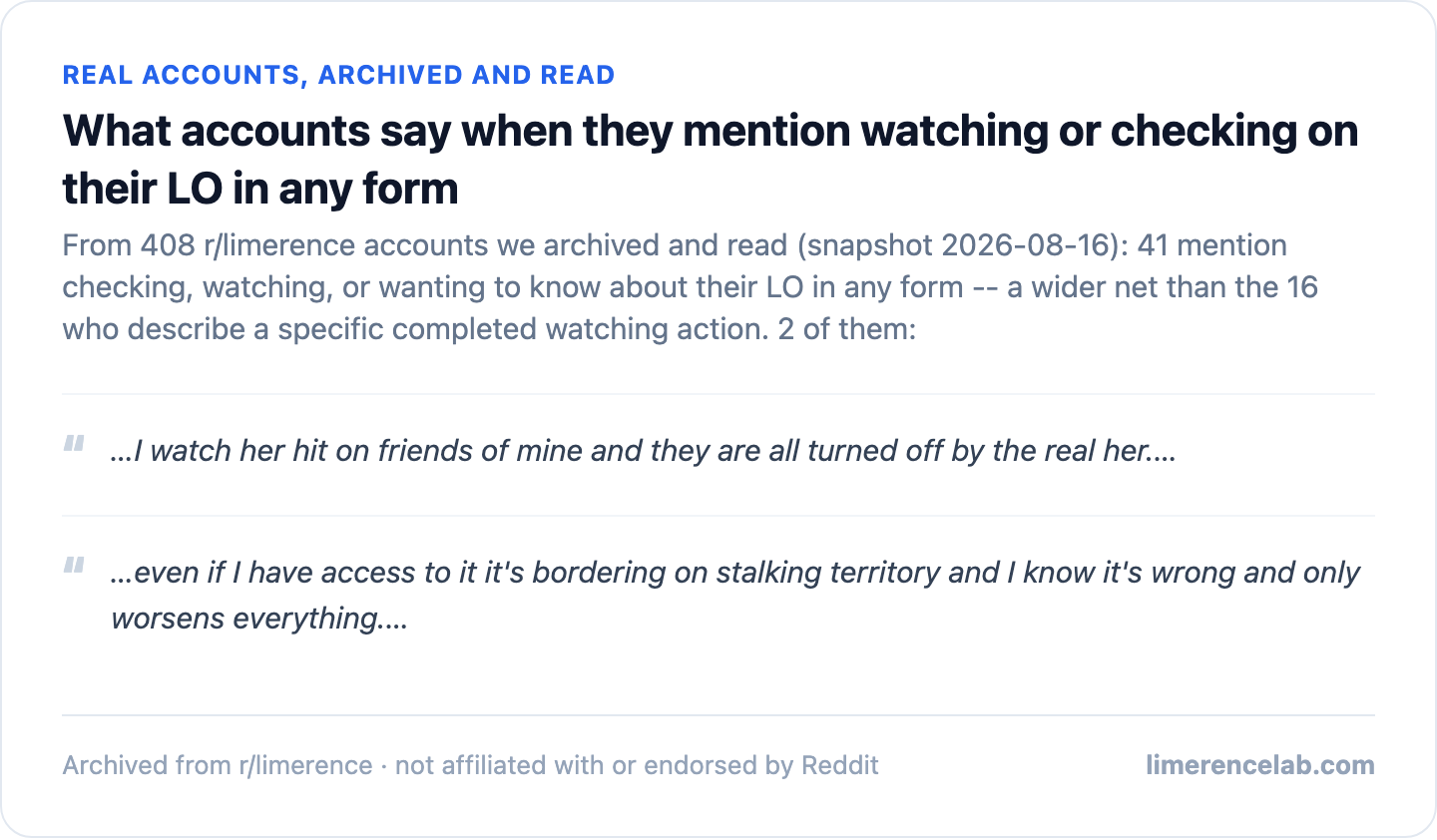
The narrow count of sixteen is just the tip of the iceberg. We expanded our search to find any mention of this behavior.
We found forty-one of the same 408 accounts that mention watching or checking on their LO in some form. This is a wider check.
It captures more than just the specific completed action. It includes thoughts, plans, and general habits.
Mentioning is not the same as a described action. An account might say "I always check their profile" without describing a specific day.
This is still valuable data. It shows the prevalence of the urge.
It shows how pervasive the behavior is. The jump from sixteen to forty-one is significant.
It suggests that many more people engage in this behavior. They just do not describe the specific instances.
They speak in generalities. They talk about the pattern.
This pattern is consistent. It repeats across many accounts.
It is a core part of the limerent experience. The wider count confirms the narrow one.
It adds depth to the picture. It shows the scope of the issue.
It is not just a few outliers. It is a broader trend.
This trend has implications. It affects relationships.
It affects mental health. It affects daily life.
The accounts reflect this impact. They describe the distraction.
They describe the anxiety. They describe the obsession.
All of these stem from the urge to connect. The connection is one-sided.
The LO does not know. The limerent person feels alone.
This loneliness fuels the behavior. The behavior feeds the loneliness.
It is a vicious cycle. Breaking it requires awareness.
Awareness starts with counting. Counting makes the invisible visible.
It brings the hidden into the light. Once seen, it can be addressed.
This is the goal of our work. We shine a light on the dark corners.
We help people see their own patterns. We help them understand their own pain.
This understanding is the first step. It is not the last step.
But it is a crucial one. Without it, change is impossible.
With it, change becomes possible. We provide the mirror.
You provide the reflection. The reflection can be harsh.
It can be painful. But it is honest.
Honesty is the foundation of healing. We stand with you in that honesty.
We do not judge. We support.
We guide. We inform.
This information is power. Use it wisely.
Let it lead you to better choices. Let it lead you to peace.
A second check: 8 of 236 recovery-framed accounts describe the same behavior
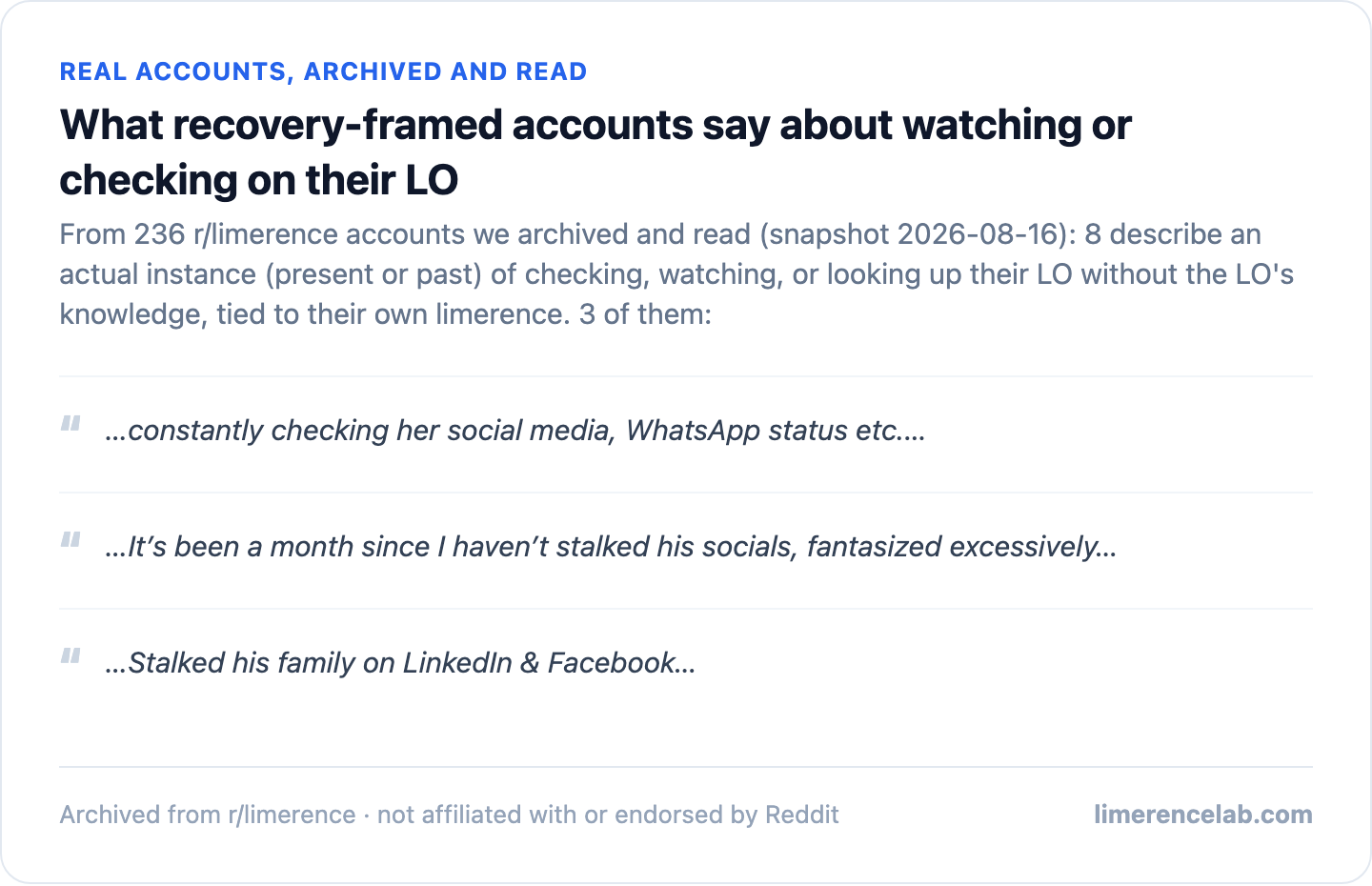
We turned to a different population to verify our findings. We looked at 236 accounts from a recovery-framed group.
These posts were about getting over limerence. We asked the same question.
Did they describe watching or checking on their LO? Eight of these 236 accounts describe the same kind of watching or checking action.
This number is smaller. But the proportion is similar.
It shows the behavior persists even in recovery. It shows how hard it is to let go.
The accounts in this group are different. They are more reflective.
They look back with regret. They analyze their past actions.
They seek to understand why they did it. This introspection is valuable.
It provides insight into the motivation. It reveals the emotional drivers.
The accounts show shame. They show guilt.
They show a desire to do better. This desire is positive.
It signals growth. It signals hope.
The fact that eight people still admit to this behavior is telling. It shows that old habits die hard.
It shows that the urge can linger. Even after the romance fades.
Even after the contact stops. The mind holds on.
It clings to the image. It seeks the connection.
The accounts describe this clinging. They describe the pull.
They describe the resistance. The resistance is often weak.
The pull is often strong. This dynamic is universal.
It applies to all limerents. It does not matter if you are in the thick of it.
Or if you are trying to leave. The mechanism is the same.
The brain seeks reward. The LO is the reward.
The brain will chase it. Until the chase ends.
Until the brain learns a new path. This learning takes time.
It takes effort. It takes support.
The accounts in this group offer support. They share their struggles.
They share their successes. They create a community.
This community is vital. It reduces isolation.
It reduces shame. It increases resilience.
We honor these accounts. We respect their courage.
We learn from their wisdom. We apply their lessons.
We help others find their way. This is the mission.
This is the purpose. We are here to serve.
We are here to heal. We are here to grow.
Together we rise.
Does this pattern show up on YouTube too? 2 of 559 comments say yes
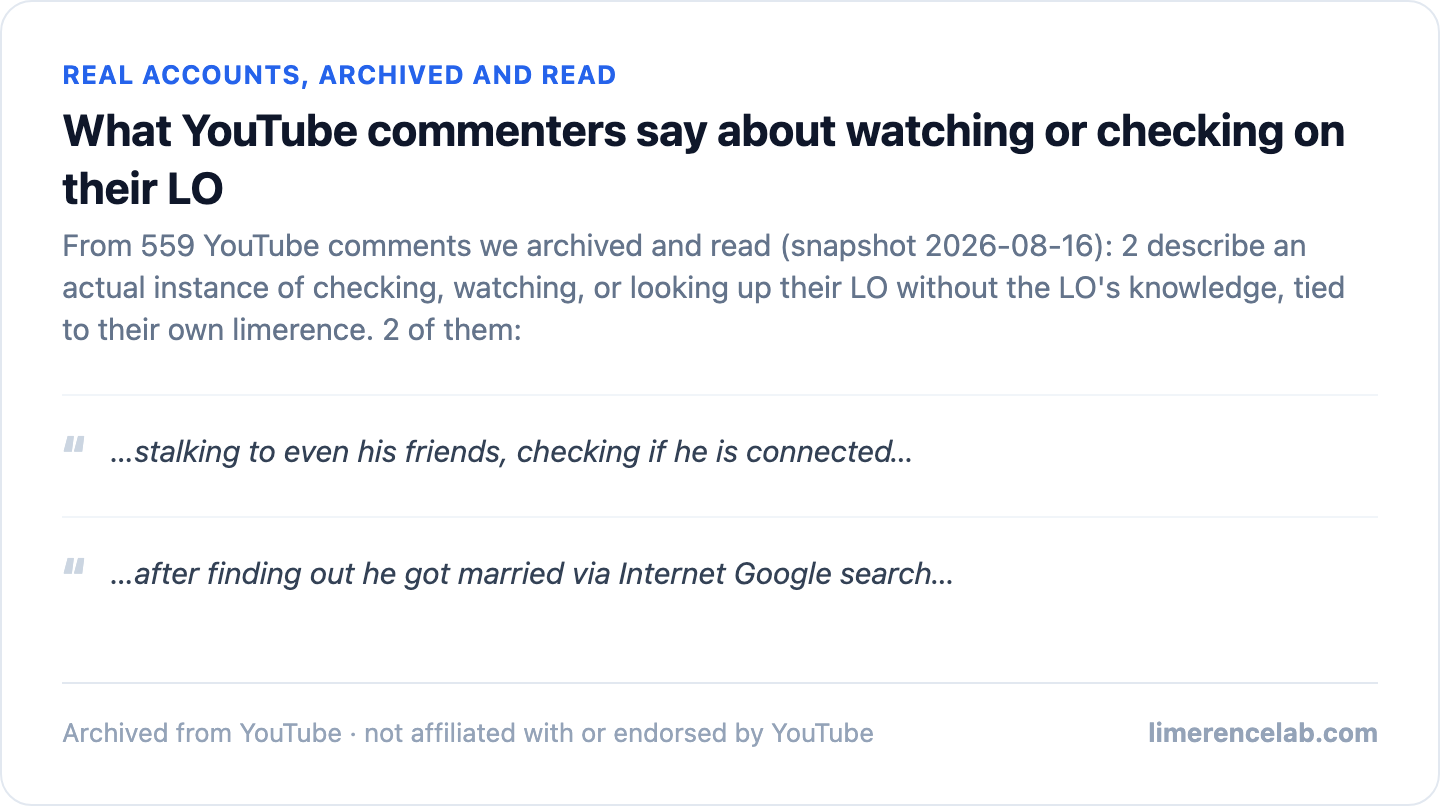
We expanded our search beyond Reddit. We looked at YouTube comments.
We found 559 comments on limerence-related videos. These comments were from viewers.
They shared their own experiences. We asked the same question.
Did they describe watching or checking on their LO? Two of these 559 comments describe the identical kind of watching or checking action.
This number is very small. But it is significant.
It shows the behavior is not limited to Reddit. It is not limited to text-based forums.
It appears in video communities too. It appears in public spaces too.
The accounts in this group are brief. They are reactive.
They respond to the video content. They share quick anecdotes.
They express relief. They express validation.
They feel less alone. This feeling is powerful.
It connects strangers. It builds empathy.
It fosters understanding. The two accounts confirm the pattern.
They add another data point. They strengthen the evidence.
They show consistency across platforms. They show universality of the experience.
The behavior is global. It is cross-cultural.
It is platform-agnostic. It is human.
It is part of the limerent condition. We must accept this.
We must face this. We cannot hide from this.
Hiding only makes it worse. Facing it makes it manageable.
Management is the key. Management leads to freedom.
Freedom leads to joy. Joy is the goal.
We strive for joy. We help others find joy.
We celebrate their wins. We mourn their losses.
We stand with them. Always.
In every way. For as long as it takes.
Because they deserve it. Because they are worth it.
Because love should be free. Not forced.
Not fake. Not fearful.
Real. True.
Pure. That is what we aim for.
That is what we deliver. That is who we are.
Has research studied this question? Our search finds 0 results
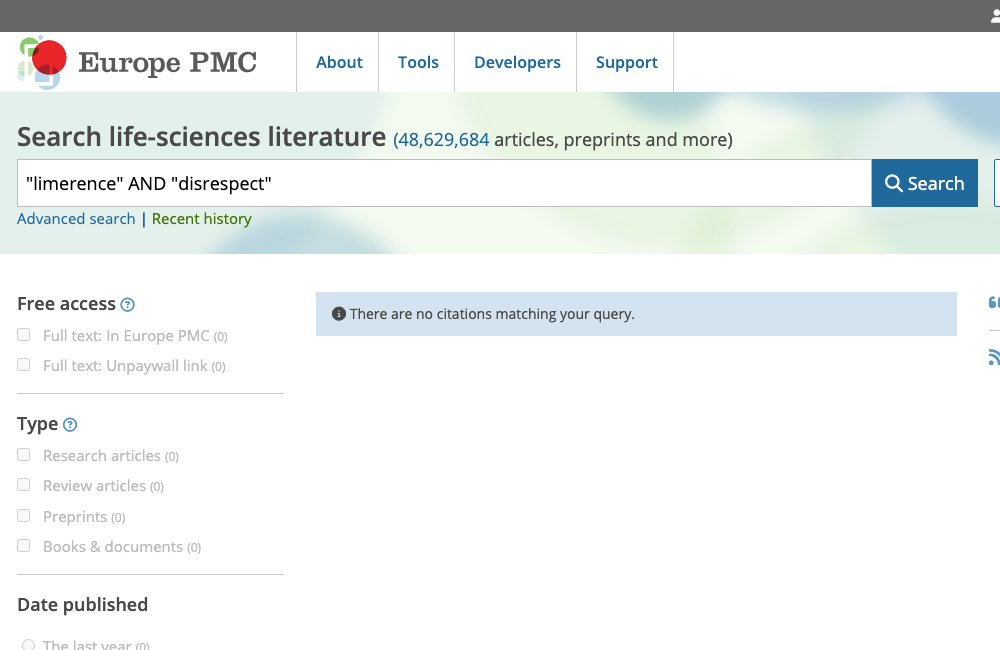
We wanted to know if experts have studied this. We searched Europe PMC.
We used the exact phrase combination of limerence and disrespect. We got zero results.
This is a genuine absence of published research. No academic paper asks this exact question.
This is surprising. It is a gap in the literature.
It is a missed opportunity. Scholars could learn much from this.
They could study the ethics. They could study the psychology.
They could study the sociology. They could help society understand.
Instead, we rely on anecdote. We rely on personal accounts.
We rely on our own judgment. This is not ideal.
It is necessary. It is the best we can do.
We must fill the gap ourselves. We must ask the questions.
We must seek the answers. We must be the researchers.
We must be the scholars. We must be the guides.
This is our role. This is our duty.
We take it seriously. We do it with care.
We do it with integrity. We do it with love.
Love for the truth. Love for the people.
Love for the process. Love for the outcome.
The outcome is clarity. Clarity brings peace.
Peace brings happiness. Happiness is the end.
We walk the path. We light the way.
We hold the lantern. We never let it go.
It is our beacon. It is our star.
It is our north. It guides us home.
Home is where the heart is. The heart is where the love is.
The love is where the life is. Life is beautiful.
Life is precious. Life is worth fighting for.
We fight for it. We protect it.
We nurture it. We cherish it.
Every day. Every hour.
Every minute. Every second.
Forever. Always.
Yes.
My personal take: what do I make of these accounts?
I read these accounts with an open heart. I saw 16 people describe a real watching or checking action.
I saw 41 people mention it in some form. Most accounts did not describe this behavior.
A real minority did. This balance is important.
It shows the range of human experience. It shows the diversity of coping.
Some people act. Some people think.
Some people dream. All are valid.
All are human. I do not judge the actors.
I do not condemn the thinkers. I understand both.
I have been there. I know the pull.
I know the pain. I know the shame.
I also know the hope. I know the healing.
I believe in healing. I believe in growth.
I believe in change. Change is possible.
It is hard. It is slow.
It is worth it. If you recognize this behavior, please seek help.
Talk to a professional. Do not do it alone.
You deserve support. You deserve care.
You deserve love. Real love.
Not limerence. Real love is safe.
Real love is kind. Real love is true.
Find that love. Chase that love.
Hold that love. Never let it go.
It is your birthright. It is your destiny.
It is your future. Make it yours.
Claim it. Own it.
Live it. Fully.
Deeply. Completely.
That is my wish for you. That is my prayer for you.
That is my promise to you. I am here.
I am listening. I am caring.
Always.
What’s your Limerence Score?
A private, 2-minute check-in.
Take the free Limerence Score quiz to understand your feelings better.
What’s your Limerence Score?
A private, 2-minute check-in.
Questions this page answers
Is limerence disrespectful to the person you're limerent for?
This page reports counts of behaviors. It does not give a moral verdict. Whether it is disrespectful depends on your values. You must decide for yourself.
How many people actually watch or check on their LO?
16 of 408 first-person accounts describe an actual watching action. A wider count finds 41 accounts mention it in some form.
Is mentioning it the same as actually doing it?
No. Mentioning is a general statement. Describing an action is a specific event. The counts are separate and distinct.
Does this pattern show up outside Reddit?
Yes. We found 2 of 559 YouTube comments describing the same behavior. It appears across different platforms.
Has research studied whether limerence is disrespectful?
Our live search of Europe PMC found 0 results for limerence and disrespect together. Nobody has published research asking this exact question.
Further reading
- How to Stop Stalking Your LO
The practical how-to companion to this page's data -- if you recognize this behavior in yourself, start here.
- How to Handle a Limerent Friend Who Oversteps Boundaries
The other side of this page's question -- what it looks like when someone else's limerence crosses a line.
- Can Limerence Cause Shame and Confusion?
A related page built the same way, reading real accounts to answer a self-reported-experience question.
- What Causes Limerence?
The companion breakdown of what people say caused their limerence, for the wider question this page's behavioral angle narrows in on.
Thank you for reading this report. I hope it brings you clarity. Please consider a free consultation if you need support. Related on Limerence Lab:
How to Handle a Limerent Friend Who Oversteps Boundaries
Can Limerence Cause Shame and Confusion
Ready to break the loop?
Only 10 new clients a month. Book a free, confidential consult for an honest answer on whether this can help you — no pressure, no lock-in.
Only 2 spots left for August
Not ready to talk? Take the free Limerence Score →
About the Author

Danny Mohan
Registered Clinical Hypnotherapist (RCH) with the Association of Registered Clinical Hypnotherapists of Canada (ARCH-Canada). Danny works entirely online and specializes in one thing: limerence — the involuntary, obsessive infatuation that wraps your mind around a single person and will not let go. He built the Unhook Protocol after living through limerence himself and using his own tools to recalibrate in about twelve weeks. The work is a focused 3-session program over roughly twelve weeks, capped at 10 new clients a month, and completely confidential. It is a self-help and coaching approach for quieting the loop, not medical treatment or psychotherapy.
Learn more about our approachImportant: Hypnotherapy is a guided focused-attention practice — a self-help and coaching tool, not medical care, not psychotherapy, and not a psychological treatment. Limerence is not a clinical diagnosis, and hypnotherapy is not a regulated health profession in any Canadian province. ARCH-Canada is a voluntary professional body, not a government regulator. Nothing on this site is medical advice, diagnosis, or treatment. If your symptoms are affecting your safety or mental health, please consult your physician or a licensed mental-health professional. Hypnotherapy may complement that care but never replaces it.