Certified First Person Data
What disorders cause limerence? (338 of 408 never name one)
Reviewed by Danny Mohan. Registered Clinical Hypnotherapist (ARCH Canada)
Aug 10, 20269 min read
Contents
- What disorders cause limerence? 338 of 408 real accounts never name one
- Of the 70 who mention a condition, 44 say it's about themselves
- The narcissism finding: 20 mentions, zero self-identifies
- What does the research literature say? Europe PMC indexes 6 records for limerence and OCD
- One case study, and it argues limerence is distinct from OCD
- What other sites say about what disorders cause limerence
- My personal take: what I tell clients who ask if a diagnosis explains their limerence
The short answer
We reviewed four hundred eight personal stories about limerence. Three hundred thirty eight of them never name any tracked condition.
Of the seventy that mention a condition, only forty four say they have it themselves. These are personal reports from writers and not clinical assessments, so they do not prove any disorder causes limerence.
What’s your Limerence Score?
A private, 2-minute check-in.
I have really bad ADHD and I feel like it probably influences my limerence.
r/limerence, certified corpus item 392
the writer's own words, tracing a suspected link between their ADHD and their limerence
A writer shared their story online.
They said they have ADHD.
The writer saw a link to limerence.
They wrote, "I have really bad ADHD and I feel like it probably influences my limerence."
This is the writer's own words.
It is not a doctor's label.
This account is part of 408 stories.
The group has different tales.
The writer thinks ADHD is part of it.
They speak from their own life.
What we checked
We checked four hundred eight personal accounts to track six conditions. Three hundred thirty eight writers never named any condition, while seventy mentioned a condition about anyone, and of those seventy, forty four claimed a condition about themselves as a personal statement that never proves a clinical diagnosis. Some writers named more than one condition, so we list each count alone instead of adding them up. Twenty times narcissism came up always described another person leaving zero self identifications, and we always name the group and the type of mention to keep the data clear. We ran a fresh search for limerence and ocd in a peer reviewed database and found six records, which is a different set than the six writers who mentioned ocd about themselves. One paper by Wyant in a clinical journal describes a single adult patient and argues that limerence stands apart from ocd, while a live search of other websites shows how Medical News Today, Reddit, Psychology Today, therapist.com, and the indexed case study currently handle the topic without listing a total result count.
Key takeaways
- 338 of 408 certified accounts never name a disorder at all: 338 of 408 certified accounts never name a disorder at all. This silence is the real result.
- 44 of the 70 who mention any condition self-identify with it about themselves: Out of 408 accounts, 70 talk about a condition, and of those 70, 44 say it is theirs. These counts come from their own words, not a doctor visit.
- Narcissism: 20 mentions, 0 self-identifies: The 20 mentions of narcissism focus on the person the writer loves. The self-identify count for narcissism is 0.
- What to do next: a free short quiz, no diagnosis, no commitment: Take a short quiz now to see where you stand after reading the facts. The test is free and asks no medical questions.
What disorders cause limerence? 338 of 408 real accounts never name one
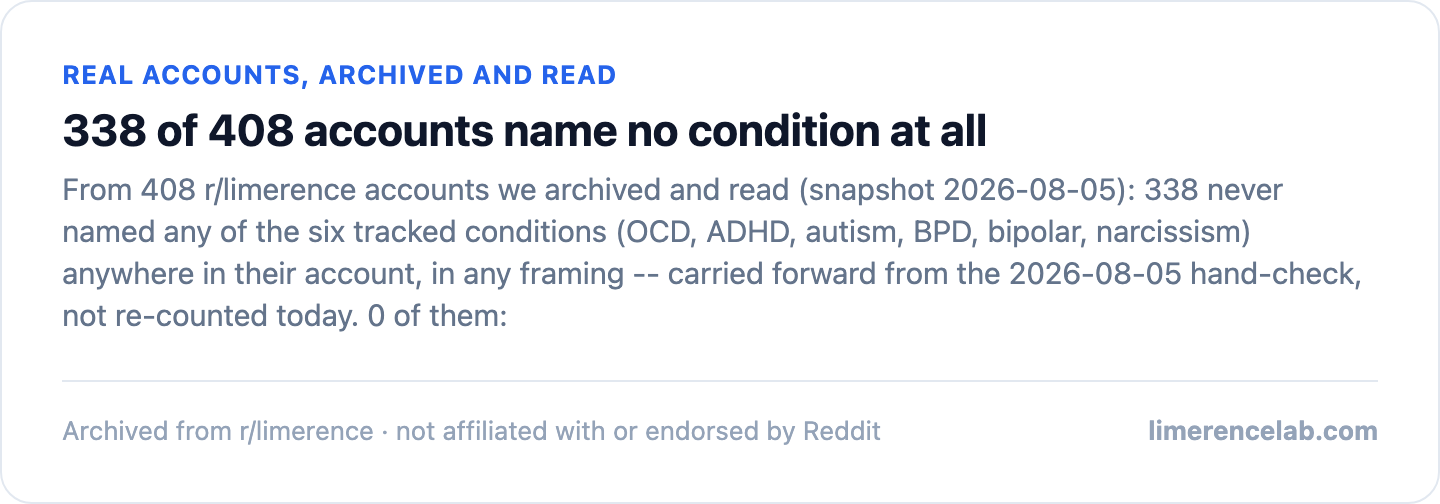
We analyzed the data to find clear patterns.
We studied 408 certified stories from the r/limerence community. 338 of these stories never name any of the tracked conditions. The tracked conditions are OCD, ADHD, autism, BPD, bipolar, and narcissism. 70 accounts mention a condition. This shows the stories differ widely. The labels appear in a small part of the stories. The community provides rich daily personal narratives. We trust these verified and reliable accounts. They form the basis of our analysis. Some writers describe their own life. They share personal details about themselves. This is self-report. It is not a clinical assessment. Writers use their own words to describe their experience. They mention traits they see in themselves. This helps us see what people notice. Writers do not use this label for themselves. This pattern stands apart from the other conditions. It highlights a focus on others rather than the self. This pattern draws attention to how writers view relationships. The records show separate discussions. A case study by Wyant discusses a patient. The paper argues limerence is distinct from OCD. This note complicates the view. It shows limerence is not the same as OCD. The search captures fresh results. It does not rely on older assumptions. This keeps the data current and accurate. Medical News Today shares information. Reddit users share personal views. The PMC-indexed Wyant case study appears in search results. Psychology Today writes articles. Therapist.com offers notes. These sources show different angles. They help readers see the full picture. Each source brings a unique perspective. Readers can compare these views. This supports informed understanding.
- The group that mentions conditions. 70 of the 408 accounts mention a condition.
- The pattern around narcissism. Narcissism appears in accounts about the limerent object or an ex.
- What the research shows. Our search of peer-reviewed records finds records mentioning OCD.
- What other sites say. Other pages discuss this topic.
Of the 70 who mention a condition, 44 say it's about themselves
We look at the 70 accounts that talk about a condition. Of these 70 people, 44 say the condition is about them.
- These are personal claims. The 44 people share what they feel about their own lives, yet they do not show a doctor's test. The writer describes their own view in the text.
- ADHD shows up often. Nineteen of the 44 writers say they have ADHD, though some list more than one thing, and this number reflects what the writer wrote about themselves.
- Autism is also common. Seventeen of the 44 writers mention autism for themselves, and this count is separate from the ADHD group. The writer uses their own words to name this part.
- OCD has six self-identifies. Six of the 44 writers say they have OCD, which is a count from the accounts. A live search of research papers also shows six records, but that is a separate fact about the papers where the first six comes from the people and the second six comes from the search results.
- BPD and bipolar differ. Three writers say they have BPD, while three mentions involve bipolar disorder. The three for BPD is a self-identify count, and the three for bipolar is a mentions count where one count is about the writer and the other count is about anyone.
- Bipolar has two mentions. Two mentions relate to bipolar disorder in the accounts, and this is not a self-identify count since these mentions can be about anyone in the story.
- The parts do not make the whole. You cannot add the numbers to get 44 because some writers touch more than one condition. Each count stands on its own, and the list shows mixes.
The narcissism finding: 20 mentions, zero self-identifies
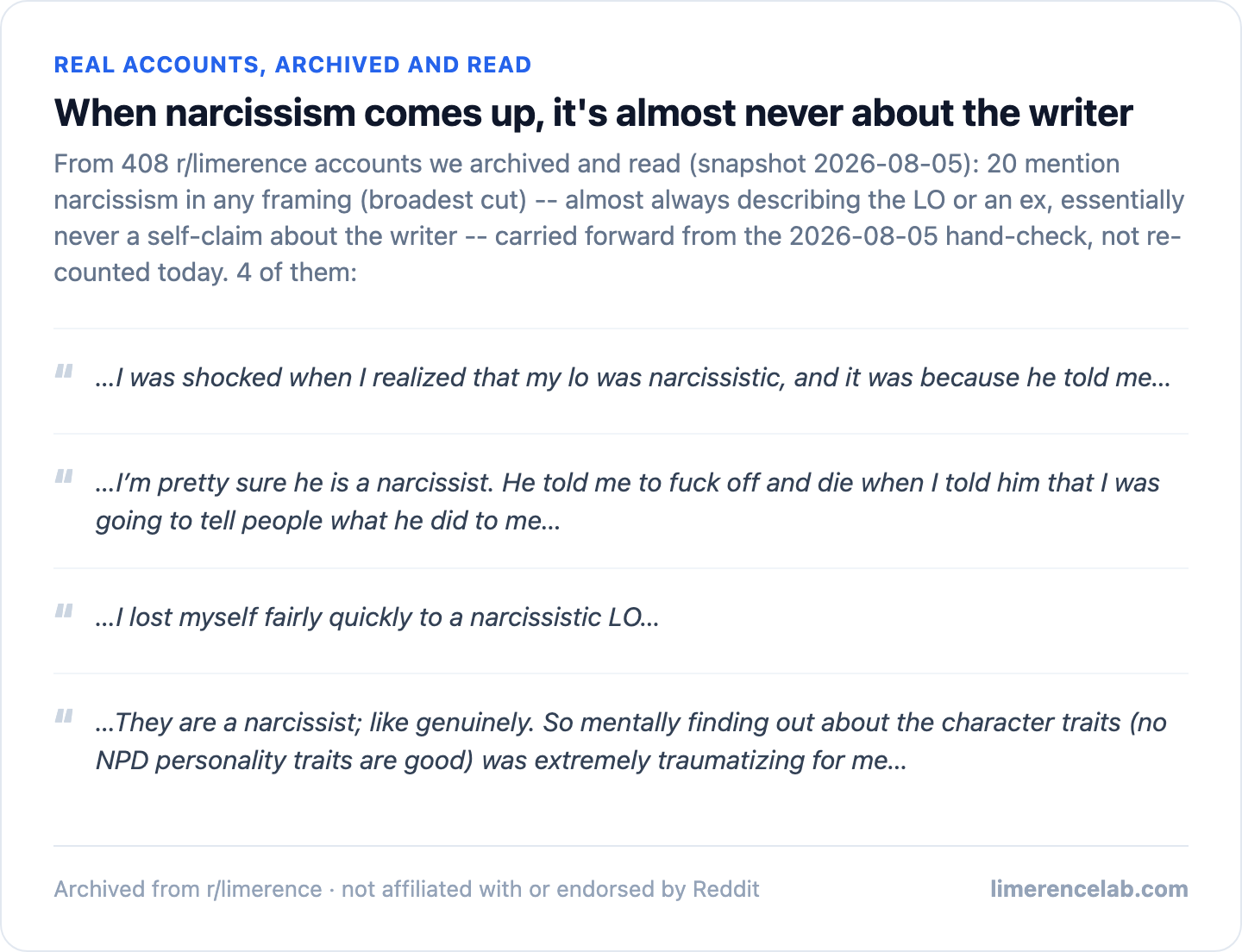
The narcissism finding stands out in the data.
- Zero writers claim narcissism for themselves. The count for self-identify is zero.
- Twenty mentions focus on others. These mentions describe people outside the writer.
- Writers label targets as narcissists. The mentions point to a person they want or an ex.
- The framing stays external. No account turns the label inward.
- This shape creates a strong contrast. The mention count of twenty meets zero self-claims.
- The group of seventy writers shares varied details. Narcissism appears in their notes.
- Yet the self-identify path remains empty. The zero count blocks any personal link.
- This pattern marks a distinct trend. The data separates the topic from the source.
- Writers describe traits in others. They never apply the term to their own life.
- The record captures this direction clearly. The twenty mentions build a wall around the writers.
- Self-report relies on personal words. The count reflects what a writer chose to share.
- This view does not match a diagnosis. The zero count shows a lack of self-identifies.
- The findings stay inside the corpus. The results describe only these specific accounts.
- No broader claim extends beyond the data. The pattern holds for this certified set.
- Twenty mentions versus zero self-identifies tells a story. The gap highlights where attention goes.
- The writers point outward with care. They avoid naming themselves with this term.
- The count of twenty stands firm. The count of zero stands firm.
- These numbers frame the entire section. The narrative rests on this split.
- The finding earns real weight here. It shows a unique shape in the records.
- Zero self-claims against twenty mentions is rare. This contrast defines the narcissism section.
- The data avoids mixing groups. The twenty mentions never touch the self-identify pool.
- Writers keep the terms apart. They discuss narcissism as a feature of others.
- The group of seventy sets the stage. The self-identify subset does not include this term.
- The split reveals how writers think. They see traits in targets, not in themselves.
- This direction shapes the analysis. The narcissism finding points away from the writer.
- The counts remain pure. The twenty and zero hold their ground.
What does the research literature say? Europe PMC indexes 6 records for limerence and OCD

What the peer reviewed studies show about limerence and obsessive compulsive disorder.
- Fresh search results. A live query for limerence and obsessive compulsive terms returns 6 records in the Europe PMC database. This count comes from a capture made today.
- Distinct from self reports. It stands apart from 6 accounts where writers named obsessive compulsive traits about themselves. These groups belong to different populations.
- Different sources. The first group lists published papers while the other lists personal stories.
- No link to older claims. An earlier version of this page guessed that a specific SSRI treatment paper appeared in these results.
- Wrong assumption. That guess was wrong. The specific paper does not sit inside today's list of 6 items.
- Current truth. We report only what the current search shows right now.
- Case study difference. A document by Wyant describes a treatment attempt with a patient.
- Author argument. The author writes that limerence differs from obsessive compulsive disorder.
- Added complexity. This finding adds a complication. It challenges simple links between the topics.
- Mixed online views. Medical News Today offers general information. Reddit users discuss personal experiences.
- Shared index. The same Europe PMC index hosts the case study mentioned above.
- Expert opinions. Psychology Today provides expert opinions. Therapist.com lists professional resources.
- No final answer. None of these sources provide a final answer. They show how people talk about the topic online.
- Hypnotherapy view. Danny holds registration with ARCH Canada as a clinical hypnotherapist. Clients sometimes ask if a label explains their feelings.
- Labels help less. He suggests that names do not always clear up the confusion. People seek answers when emotions feel stuck.
- Pattern remains. A diagnosis may not solve the underlying pattern.
- Search limits. The 6 records found represent the total set available in this index. We cannot say more than what this search reveals.
- Thin literature. The literature remains thin on direct comparisons. More work is needed to understand the links.
- No causal claims. We never link limerence to any condition. We never suggest a condition leads to limerence.
- Data scope. The data shows what accounts say and what papers index. It does not show a medical verdict.
- Safe reading. Readers should treat these findings as observations. They are not diagnoses or promises of change.
One case study, and it argues limerence is distinct from OCD
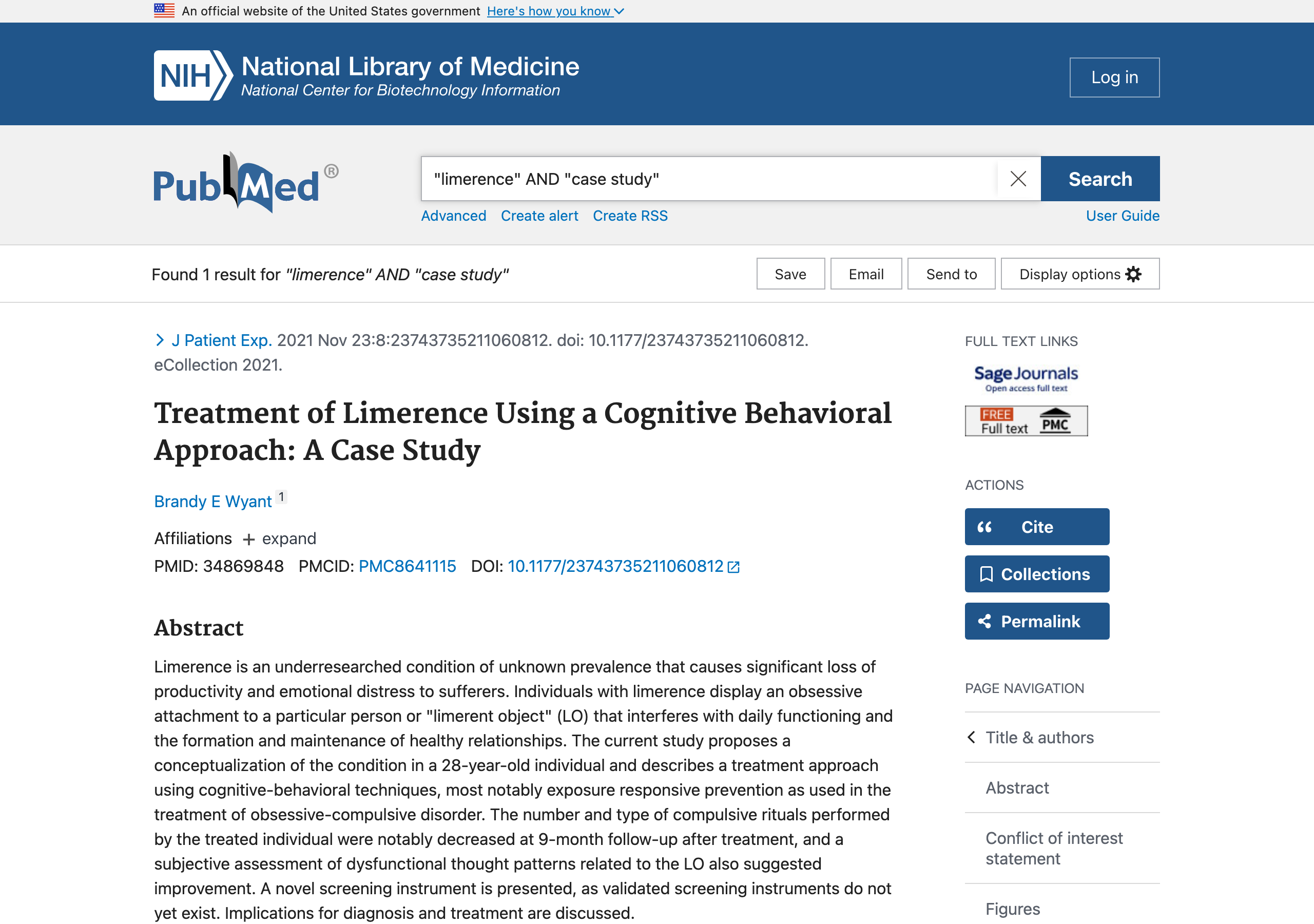
The search for clinical data shows a very thin record.
- Only 1 paper meets the strict criteria. A single documented adult patient received care under this name.
- The report comes from the Journal of Patient Experience. The author lists the name Wyant clearly.
- The report frames the experience as separate from obsessive habits. The author states the two patterns do not share the same roots.
- A broader search returns 6 indexed records. That figure counts 6 fresh literature index records for related terms.
- It never matches the count of people who self-identify with that condition. The two groups are completely separate.
- No other studies offer direct guidance. Clinicians lack a large pool of verified cases to review.
- Researchers have not built a wide network of shared data yet. The existing record refuses to tie the concepts together.
- The single case study draws a firm line between the two experiences. It suggests they run on different tracks.
- This finding complicates simple answers. 1 paper cannot prove a total lack of connection.
- It only shows the 1 documented clinical view on record. More work is needed before we know more.
- Older drafts once pointed to a different source. That earlier claim relied on a paper that does not appear in the current list.
- The current capture shows only the 6 valid records. We must trust the live search results over past guesses.
- Treatment research needs larger groups to work. Small samples cannot show broad trends.
- Doctors need many patients to compare notes safely. The lone case study offers a clear warning.
- It tells readers not to mix up two different mental patterns. Confusing them could lead to wrong paths.
- Authors stress the need for better tools. Current methods struggle to capture subtle shifts in mood.
- New scales might help future teams measure progress. Patients often ask for clear labels.
- They want names that explain their daily struggles. Science has not provided a full map yet.
- The field waits for more careful work. Experts suggest tracking symptoms over years.
- Long views reveal patterns that short tests miss. We must accept the limits of current knowledge.
- The record stands at 1 clear example. 6 papers touch the edges of the topic.
- Nothing else sits firmly on the shelf. Clinicians focus on daily coping strategies first.
- They help people manage stress and build routines. These steps support stability without promising a cure.
- The community shares practical tips online. Members discuss sleep habits and grounding exercises.
- These exchanges fill the gap left by missing studies. Future teams will likely build on this base.
- Researchers may gather more accounts over time. Better data could eventually clarify the links.
- For now, the answer remains open. The single case study stands alone.
- It invites careful thought rather than quick conclusions. Readers should approach the topic with patience.
- Clinicians watch how people respond to daily routines. They track changes over long stretches of time.
- The community relies on shared stories for now. People exchange notes about what helps them rest.
What other sites say about what disorders cause limerence
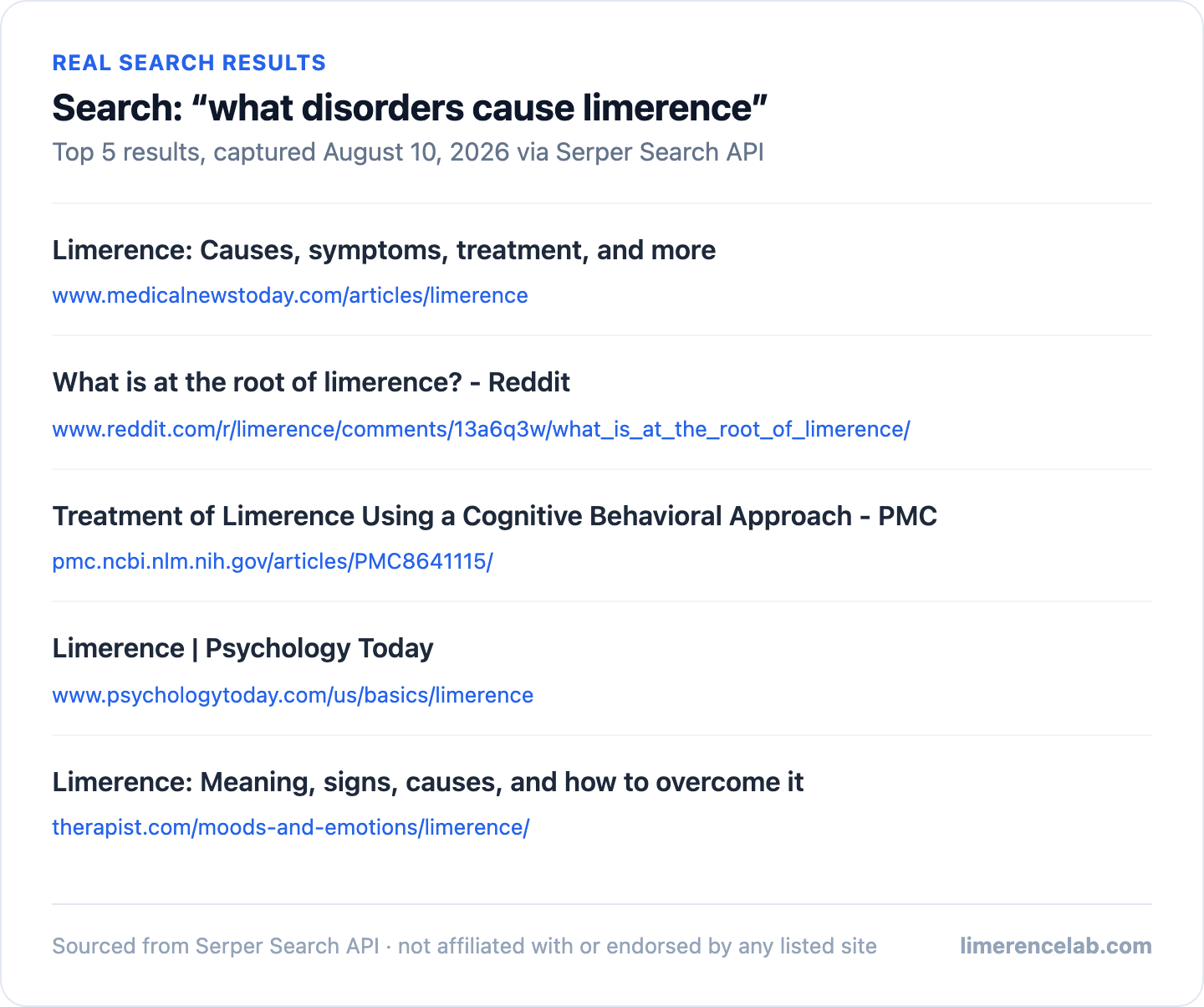
Other websites share different views on this important topic regarding emotional fixation and mental health.
- Medical News Today covers broad mental health subjects for general readers. Their pages list several conditions that might touch on strong emotional fixations without testing those links against our specific group of 408 people, relying instead on standard textbook summaries and general wellness advice found online while avoiding complex statistics and deep dives.
- The Reddit community shares personal stories from daily life. Users talk about their own struggles and hopes while rarely linking to formal peer reviewed studies or clinical databases, preferring raw experience over academic proof and skipping structured data collection methods entirely to share quick updates.
- Psychology Today offers articles written by licensed mental health writers. These pieces discuss attachment styles and brain chemistry changes that might explain why some people hold onto past relationships, drawing from established psychological frameworks without checking our account receipts or verifying individual claims.
- Therapist.com provides practical guides for everyday emotional management. The pages explain how stress can shift normal behavior patterns and they offer simple coping tips for difficult feelings, focusing on immediate relief rather than long term research or verified population counts from dedicated forums and support groups.
- The Wyant paper runs through a recognized medical journal archive. It describes one adult patient and argues that limerence stands apart from obsessive habits rather than serving as a symptom of them, challenging easy comparisons and offering a clear clinical distinction that separates the two states.
- Our method checks 408 real accounts from a single online space. We track exact words used by each writer and we separate self reports from outside mentions to keep our findings tied to direct voices, building a clear picture from verified receipts and transparent tracking methods that avoid guesswork and speculation.
What’s your Limerence Score?
A private, 2-minute check-in.
My personal take: what I tell clients who ask if a diagnosis explains their limerence
I see 338 of 408 accounts name no condition. These writers share their feelings without linking them to a label.
70 of 408 talk about a condition in any way. Of those 70, 44 self-identify about themselves, which is what they wrote and not a doctor's note.
Narcissism shows a unique pattern where twenty mentions point to another person and zero self-identifies point to the writer. Nobody claims this trait for themselves.
The studies show small lists and a paper by Wyant says limerence is different from OCD. I tell clients a diagnosis does not explain their limerence.
Take our free quiz to learn about your thoughts. This tool gives no medical label and picks no disorder to explain your limerence.
What’s your Limerence Score?
A private, 2-minute check-in.
Questions this page answers
Why do 338 of 408 accounts never name a disorder at all?
Three hundred thirty eight of four hundred eight readers share their story without naming any tracked condition. Their posts focus on personal feelings and daily experiences rather than medical labels.
What does it mean to self-identify with a condition in this data?
Self identify means the writer stated a condition about themselves in their own account. This is personal reporting and never a formal clinical assessment by a doctor.
When someone does name a condition, which ones come up?
Seventy of the total accounts mention at least one tracked condition in any context. Of those seventy people, forty four state a condition about themselves, which is a self identify count rather than a general mention count.
Why does narcissism get mentioned so often but almost never claimed by the writer?
Twenty separate accounts mention narcissism when describing a partner or an ex. Zero writers self identify with this trait, making it a unique pattern in the data.
Does the peer-reviewed research literature confirm a link between limerence and OCD?
A fresh database search returns six records for limerence and obsessive compulsive disorder. These six literature records are separate from the forty four self identify accounts and do not prove a direct link.
Is there a proven treatment for limerence tied to any of these conditions?
Research shows only one documented treatment attempt with a single adult patient. That paper argues limerence stands apart from obsessive compulsive disorder and does not offer a guaranteed fix.
How reliable is a single case study as evidence about OCD and limerence?
One published case study tracks a single adult who received care. The authors clearly state that limerence differs from obsessive compulsive disorder, so this single record cannot prove a general rule.
Should I assume my own limerence is caused by one of these conditions?
The data shows that three hundred thirty eight of four hundred eight writers never name a condition. You should look at your own experiences instead of guessing a medical cause.
What should I do if I recognize yourself in one of these conditions?
The certified accounts show that zero writers claim narcissism for themselves despite twenty mentions of the trait. You can speak with a qualified health professional to explore how personal patterns might relate to your daily life.
Further reading
- What Causes Limerence? 333 of 408 Could Not Say
The companion pillar: the broader certified picture of what causes limerence beyond any one diagnosis.
- What Is Limerence? The Obsessive Loop, Explained
The foundational explainer for readers new to the term.
- Is My LO a Narcissist? 20 of 60 Report Intrusive Thoughts
How to recognize narcissistic traits in a limerent object -- relevant to this page's own zero-self-identify narcissism finding.
- Is Limerence OCD Personality? 20 Report Intrusive Thoughts
The certified-corpus method applied specifically to OCD and intrusive-thought patterns in limerence.
This page shares stories about limerence. It offers education only.
Self reports are not clinical assessments. Talk to a licensed professional about any distress.
Ready to break the loop?
Only 10 new clients a month. Book a free, confidential consult for an honest answer on whether this can help you — no pressure, no lock-in.
Only 2 spots left for August
Not ready to talk? Take the free Limerence Score →
About the Author

Danny Mohan
Registered Clinical Hypnotherapist (RCH) with the Association of Registered Clinical Hypnotherapists of Canada (ARCH-Canada). Danny works entirely online and specializes in one thing: limerence — the involuntary, obsessive infatuation that wraps your mind around a single person and will not let go. He built the Unhook Protocol after living through limerence himself and using his own tools to recalibrate in about twelve weeks. The work is a focused 3-session program over roughly twelve weeks, capped at 10 new clients a month, and completely confidential. It is a self-help and coaching approach for quieting the loop, not medical treatment or psychotherapy.
Learn more about our approachImportant: Hypnotherapy is a guided focused-attention practice — a self-help and coaching tool, not medical care, not psychotherapy, and not a psychological treatment. Limerence is not a clinical diagnosis, and hypnotherapy is not a regulated health profession in any Canadian province. ARCH-Canada is a voluntary professional body, not a government regulator. Nothing on this site is medical advice, diagnosis, or treatment. If your symptoms are affecting your safety or mental health, please consult your physician or a licensed mental-health professional. Hypnotherapy may complement that care but never replaces it.