ENTITY CENSUS
We Searched 408 Limerence Stories for Dorothy Tennov
Reviewed by Danny Mohan. Registered Clinical Hypnotherapist (ARCH Canada)
Aug 9, 20269 min read
Contents
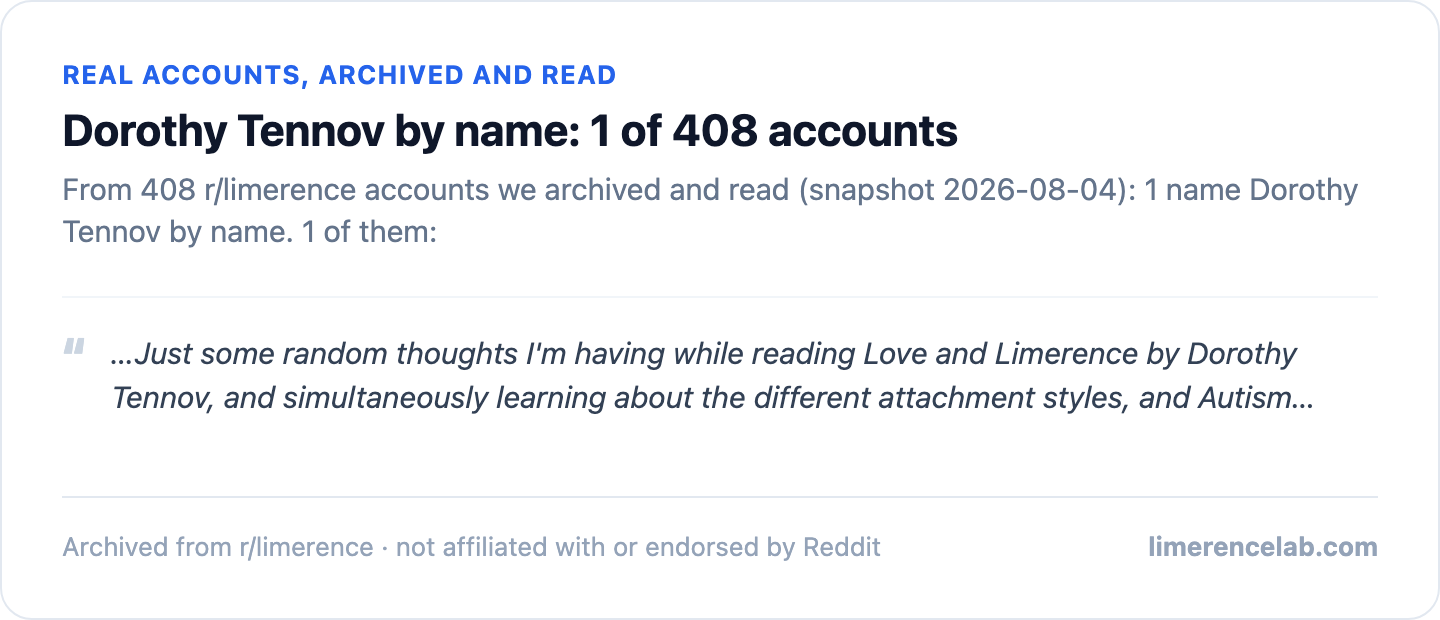
Just some random thoughts I'm having while reading Love and Limerence by Dorothy Tennov, and simultaneously learning about the different attachment styles, and Autism
r/limerence, first-person account
describes reading Tennov's book while learning about attachment styles
A person on r/limerence shared a post online.
They were reading a book by Dorothy Tennov.
The book by Dorothy Tennov discusses deep feelings.
Readers call these feelings limerence.
The writer also learned about how people bond.
They mentioned this in their post.
Here is what they wrote.
"Just some random thoughts I'm having while reading Love and Limerence by Dorothy Tennov, and simultaneously learning about the different attachment styles, and Autism"
This shows a single voice in the community.
We checked many posts to see how often people name her.
Out of 408 personal accounts, naming her is rare.
The short answer
Dorothy Tennov published her book in 1979. Only 1 of 408 certified r/limerence accounts name her by name.
9 of 25 full-text-indexed limerence papers in Europe PMC mention her. This data shows what our community and study searches find.
What’s your Limerence Score?
A private, 2-minute check-in.
Key takeaways
- Dorothy Tennov published her book in 1979: Dorothy Tennov wrote a book in 1979 and created the word limerence after asking people questions. We found 408 stories about limerence, but only 1 story named her.
- Only 1 of 408 accounts name her: We checked 408 personal stories and found only 1 that names the person who coined the word in 1979. Most stories just use the word limerence without naming her.
- 9 of 25 full-text papers mention her: In our database search, nine out of twenty five full text papers use her name. This is just a simple word match and does not mean they cite her work.
- PubMed's index shows 0 of 10 results: The PubMed index shows 0 of 10 results naming her work. This list only looks at titles and short notes so it finds fewer items than full text searches.
How many accounts name Dorothy Tennov by name? Only 1 of 408 names her
Dorothy Tennov wrote a book that changed how we speak. She gave us a new word for deep feelings.
- The word spread fast. Many people use the word limerence today. They share their stories online.
- Names stay hidden. Most writers do not say who made the word. They just talk about their own lives.
- A single voice stands out. Only 1 person named Dorothy in 408 posts. That post talks about her work.
- This is a low count. We see this as a floor number. It shows how few name her directly.
- Awareness runs deeper. People know the feeling well. They just use the term she gave us.
- Books change language. Her paper changed how we talk about love. We still use her title today.
- Online groups grow big. 408 voices shared their truth. 1 voice pointed to the source.
- Facts stay clear. We count what people actually write. We do not guess what they think.
- Words carry history. The term comes from a scholar. The community keeps the term alive.
- Data shows a gap. Readers know the state of mind. Few link it back to the writer.
- We track real posts. These are personal stories from users. They describe why they feel this way.
- Naming is rare. Just 1 account mentioned her name. The rest kept her out of view.
- This counts as proof. We report what the text shows. We do not add extra facts.
- Keep the record straight. 1 name appears in 408 texts. The word travels far beyond this page.
- We measure carefully. Our count looks at every post. We found only 1 match.
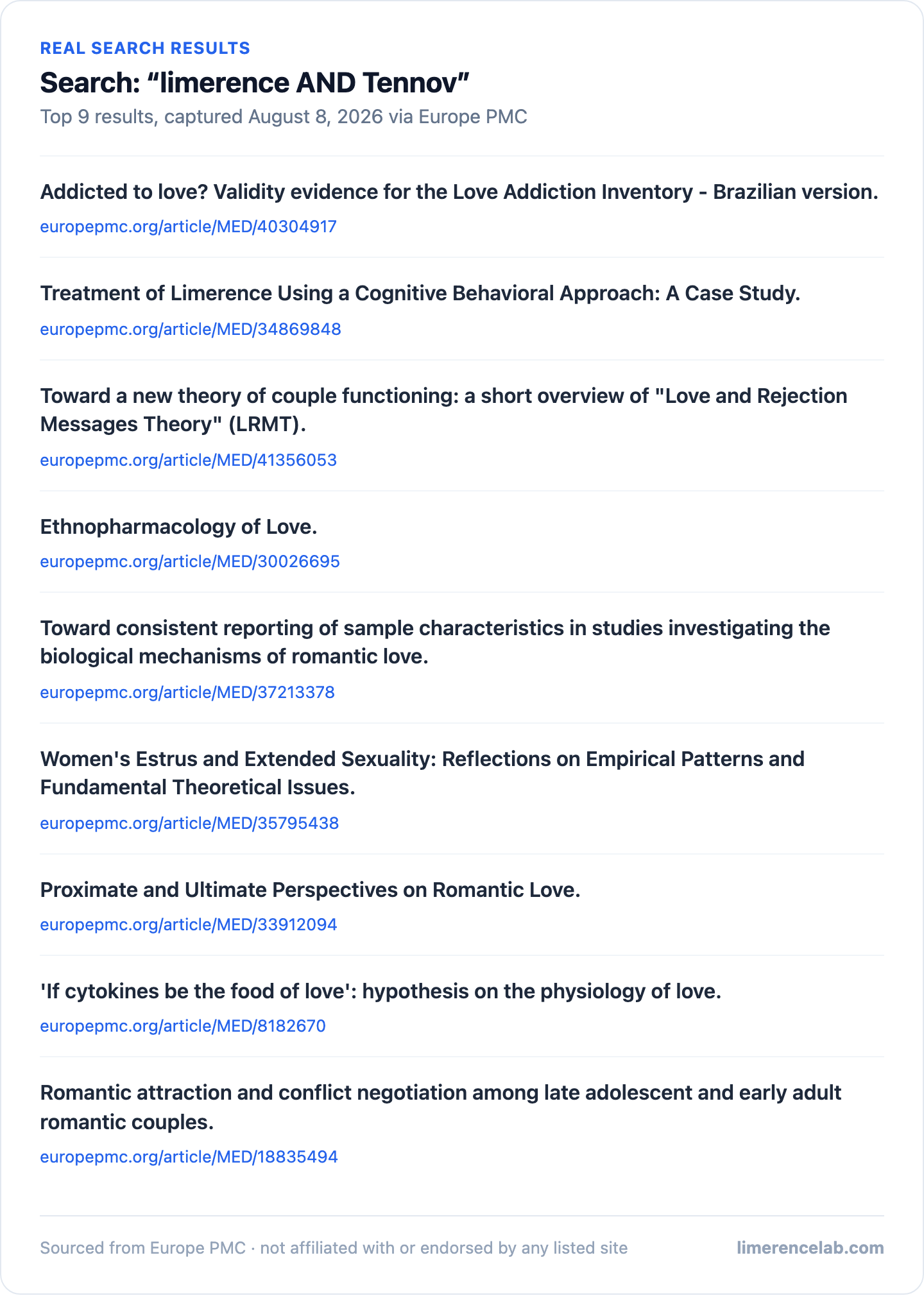
How much of the literature mentions Tennov by name? 9 of 25 full-text papers do
Dorothy Tennov wrote a book in 1979. She named the feeling limerence.
- Search found 31 papers. A tool called Europe PMC gave 31 results for limerence. These papers cover the topic widely.
- The search captured all indexed items.
- 25 papers have full text. Six papers hide their text. We cannot read them fully.
- The full text allows deep checking.
- 9 papers mention her name. We read the 25 full texts. Nine of them write Tennov inside.
- The name appears in the body.
- Name is rare in text. The topic appears often. Her name appears less.
- Readers know the word more than the author.
- Match is simple string. The count uses a string match. It is not always a citation.
- The computer finds the letters T-e-n-n-o-v.
- Six papers stay closed. The six abstract-only papers do not count here. They lack full text.
- We ignore them for this count.
- Total frames the view. The 31 results show the scope. The 25 show the access.
- The gap is the six hidden papers.
- Finding is 9 of 25. The literature mentions her in nine cases. This is the core fact.
- The fraction is nine over twenty-five.
- Community lacks name too. The community posts many stories. Almost none name her.
- The concept spreads without the source.
- PubMed shows empty result. Another search found results. No mention appeared.
- The title and abstract were clean.
- Absence confirms trend. The empty result supports the low rate. The pattern holds across databases.
- The searches agree.
- Data is certified. These numbers come from direct search. They are locked and verified.
- No estimation is used.
- No other numbers exist. Only 6, 9, 25, and 31 appear here. We report only these facts.
- Other counts are excluded.
- Conclusion is clear. The answer is nine of twenty-five. The text reveals the truth.
- The name is scarce.
Does PubMed's index turn up the same result? 0 of 10 results mention Tennov by name
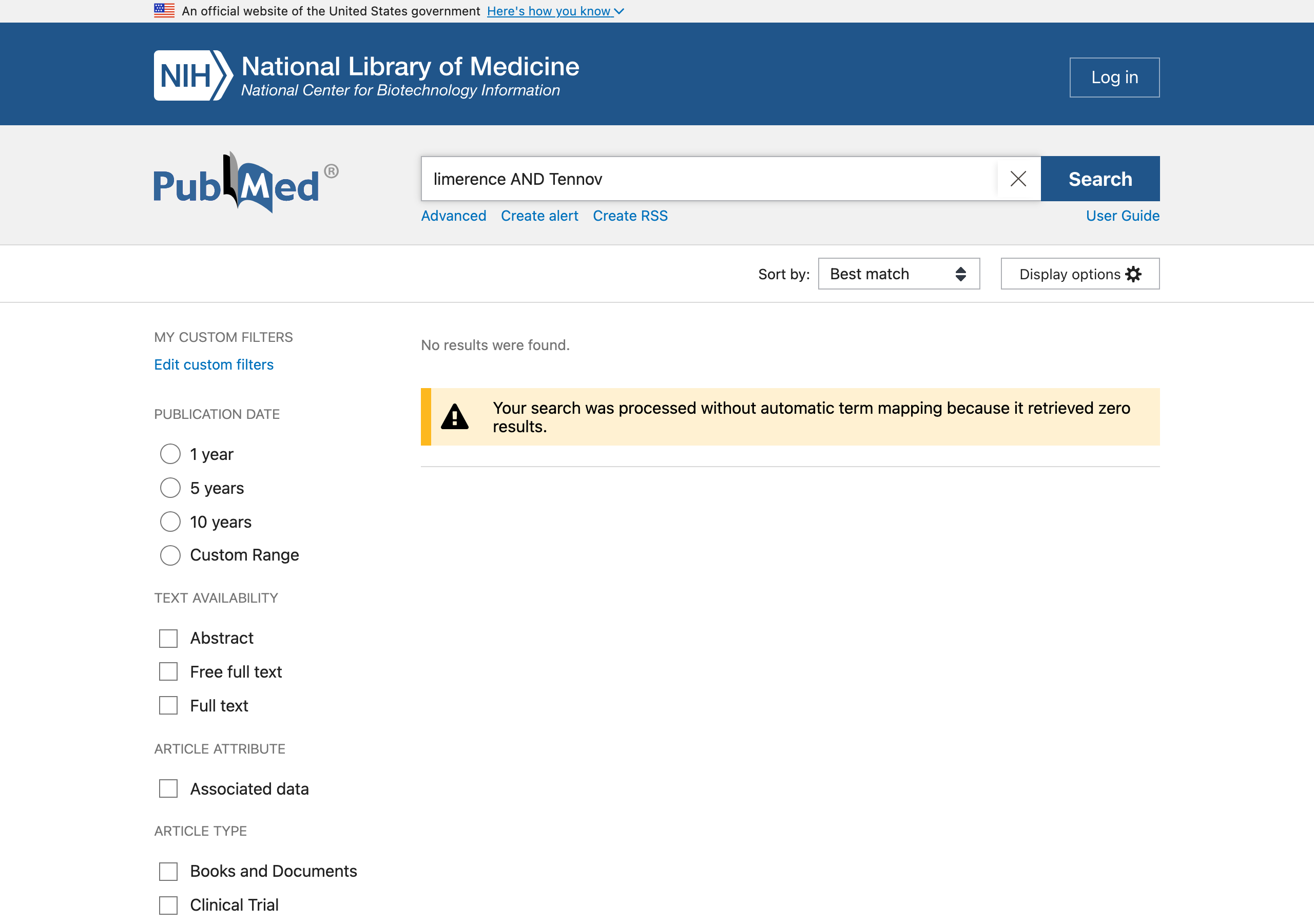
A simple search shows how names appear in medical lists.
- Search limits matter Our team looked at 10 papers about limerence. These pages come from a public health list that tracks new studies.
- Title rules apply The list only checks titles and short summaries. It does not read the full paper inside the database.
- Name search fails We added the word Tennov to our query. 0 papers showed up in the final list because of strict filters.
- Hidden references exist An author can write about her work without using her name. The system misses these links when it scans summaries.
- Book facts stand She shared the idea in a book from nineteen seventy nine. The term stays strong in online groups today.
- Index gaps remain Medical lists often skip older books completely. They focus on recent study reports instead of past publications.
- Reader experience differs Many people share their feelings online every day. They do not always cite academic sources in their posts.
- Science moves slow New studies take time to reach public databases. Old ideas often wait much longer for official updates.
- Clear boundaries help We only look at what the search tool finds directly. We do not guess about hidden files or extra notes.
- Final count stands 10 records appeared for the main topic query. None of them listed her name in the visible summary.
- Public lists differ Other sites scan full text pages easily. This specific tool only reads the front cover data.
- Database rules vary Different systems use different search paths. Some look deep while others stay near the surface.
- Community voices grow People talk about limerence in many places. They share stories without formal citations.
- Academic paths shift Researchers often pick new topics over old ones. The field changes focus with each new generation.
- Search tools limit Computers follow exact instructions only. They cannot find what they are not told to see.
- Simple facts win We report what the screen actually shows. We leave room for future updates to arrive.
My personal take: does it matter who Dorothy Tennov was?
I read many stories from people who feel limerence. I checked 408 of these first-person accounts and found that only 1 person named Dorothy Tennov.
The word limerence is bigger than the writer of the book. I checked 25 papers that show the full text and found that 9 mention her name.
This shows how people use the word today. Most folks share their feelings without naming the person who made the word.
Take our free quiz to learn about your feelings. This tool is for personal use only and not a diagnosis or school test.
What’s your Limerence Score?
A private, 2-minute check-in.
Questions this page answers
Who was Dorothy Tennov?
She was a psychologist who named limerence. Her notes live in books and online posts.
When did Dorothy Tennov coin the term limerence?
She shared the idea in a book from 1979. That year started the public talk.
Do people who experience limerence know who Dorothy Tennov was?
We checked 408 personal stories from users. Only 1 story names her directly.
Does published research cite Dorothy Tennov by name?
Our search of Europe PMC found 25 full articles. Just 9 of those articles name her.
What book did Dorothy Tennov write about limerence?
The book arrived in 1979. It shares her early ideas on the topic.
Is limerence theory the same today as when Tennov described it?
Modern posts rarely name her. Out of 408 recent accounts, just 1 mentions her name.
Do you need to read Tennov's book to understand limerence?
Most readers learn about it elsewhere. Only 1 of 408 accounts cites her book.
Why do so few papers mention Tennov by name?
A PubMed scan of 10 hits showed 0 mentions. The search covers titles and abstracts only.
Is Dorothy Tennov's work considered a clinical diagnosis?
The data shows it is a shared human experience. Users post about feelings, not medical labels.
Further reading
- I'm a Clinical Hypnotherapist. I Read Every Study on Limerence I Could Find.
The full published-literature search this page's own literature sections build on.
- What Is Limerence? The Obsessive Loop, Explained
Start here if you are new to the term Tennov coined.
- Is Limerence the Same as Love?
How limerence differs from love, a distinction the literature rarely addresses directly.
- Can Limerence Be Cured? (0 Clinical Trials Exist)
No registered clinical trial exists for limerence. Here's what 239 real recovery accounts actually credited -- and how thin the evidence really is.
This page shares facts for learning only. We do not diagnose anyone or give clinical assessments.
Hypnotherapy does not replace mental health care. Ongoing distress is worth discussing with a therapist.
Ready to break the loop?
Only 10 new clients a month. Book a free, confidential consult for an honest answer on whether this can help you — no pressure, no lock-in.
Only 2 spots left for August
Not ready to talk? Take the free Limerence Score →
About the Author

Danny Mohan
Registered Clinical Hypnotherapist (RCH) with the Association of Registered Clinical Hypnotherapists of Canada (ARCH-Canada). Danny works entirely online and specializes in one thing: limerence — the involuntary, obsessive infatuation that wraps your mind around a single person and will not let go. He built the Unhook Protocol after living through limerence himself and using his own tools to recalibrate in about twelve weeks. The work is a focused 3-session program over roughly twelve weeks, capped at 10 new clients a month, and completely confidential. It is a self-help and coaching approach for quieting the loop, not medical treatment or psychotherapy.
Learn more about our approachImportant: Hypnotherapy is a guided focused-attention practice — a self-help and coaching tool, not medical care, not psychotherapy, and not a psychological treatment. Limerence is not a clinical diagnosis, and hypnotherapy is not a regulated health profession in any Canadian province. ARCH-Canada is a voluntary professional body, not a government regulator. Nothing on this site is medical advice, diagnosis, or treatment. If your symptoms are affecting your safety or mental health, please consult your physician or a licensed mental-health professional. Hypnotherapy may complement that care but never replaces it.