Evidence Check
Can Limerence Be Cured? (0 Clinical Trials Exist)
Reviewed by Danny Mohan. Registered Clinical Hypnotherapist (ARCH Canada)
Aug 10, 20269 min read
Contents
- Can limerence be cured? No registered clinical trial has ever tested it
- The entire published treatment literature is one case study
- Of 239 recovery accounts, 4 credited a specific self-rebuilding action
- 14 more mentioned trying something, and never said if it worked
- A broader cut: 10 of 239 credited any method, no modality dominates
- Europe PMC's entire 'limerence and therapy' literature: 6 results
- What other sites claim about curing limerence
- My personal take: why I still think change is possible, even though the evidence is this thin
The short answer
Our live search of ClinicalTrials.gov returns 0 registered trials for this topic. The only published report is 1 literature case study that tracks one adult patient.
In our review of 239 shared recovery stories, 4 people credited a daily habit like exercise as what actually helped. A wider look at those same stories finds 10 accounts that mentioned using therapy or another method, though the current data does not prove a cure exists.
What’s your Limerence Score?
A private, 2-minute check-in.
Healing is not linear and I have been through so many ups and downs, but it has never felt quite as terrible as that last day.
r/limerence, certified corpus item 8
the writer's own words on how difficult and non-linear recovery actually felt
A person shared their story online.
They faced a long road back to normal life.
They described the hard work of moving on.
"Healing is not linear and I have been through so many ups and downs, but it has never felt quite as terrible as that last day."
A review of 239 accounts shows a steady trend.
Recovery takes time and careful work.
Quick fixes do not exist for this kind of pain.
People must find their own steady pace.
What we checked
We searched ClinicalTrials.gov and found 0 results. We checked Europe PMC and saw 6 records including 1 published study of one patient.
We reviewed a list of 239 people who shared recovery stories and found 4 people who said an action to rebuild life helped them. We also found 14 people who mentioned a similar action without saying if it worked, and these counts are different from the 10 people who said a method helped and never add up.
This group has 1 person who said DBT helped but leaves out 1 person who said CBT helped in a separate group. ERP had 0 people, Schema had 0 people, IFS had 0 people, EMDR had 0 people, and Hypnotherapy had 0 people.
Key takeaways
- No registered clinical trial for limerence exists (0 on ClinicalTrials.gov): A live search of the ClinicalTrials.gov registry returns 0 registered trials for limerence. The wider research base holds just 1 published case study and 239 self reported accounts that show no proven path forward.
- The entire published treatment literature is 1 case study: The whole published guide on treatment holds just 1 case study. This single report covers one adult patient and is the only known clinical try, but it does not prove any fix works for everyone.
- 4 of 239 credited a specific action, 14 more mentioned one without saying if it helped: 4 of 239 credited a specific action as what worked. 14 of 239 mentioned trying a similar step but did not say if it helped.
- What to do next: a free short quiz, no cure claim, no commitment: Take a free short quiz to learn more. The quiz asks simple questions and gives no cure promise.
Can limerence be cured? No registered clinical trial has ever tested it
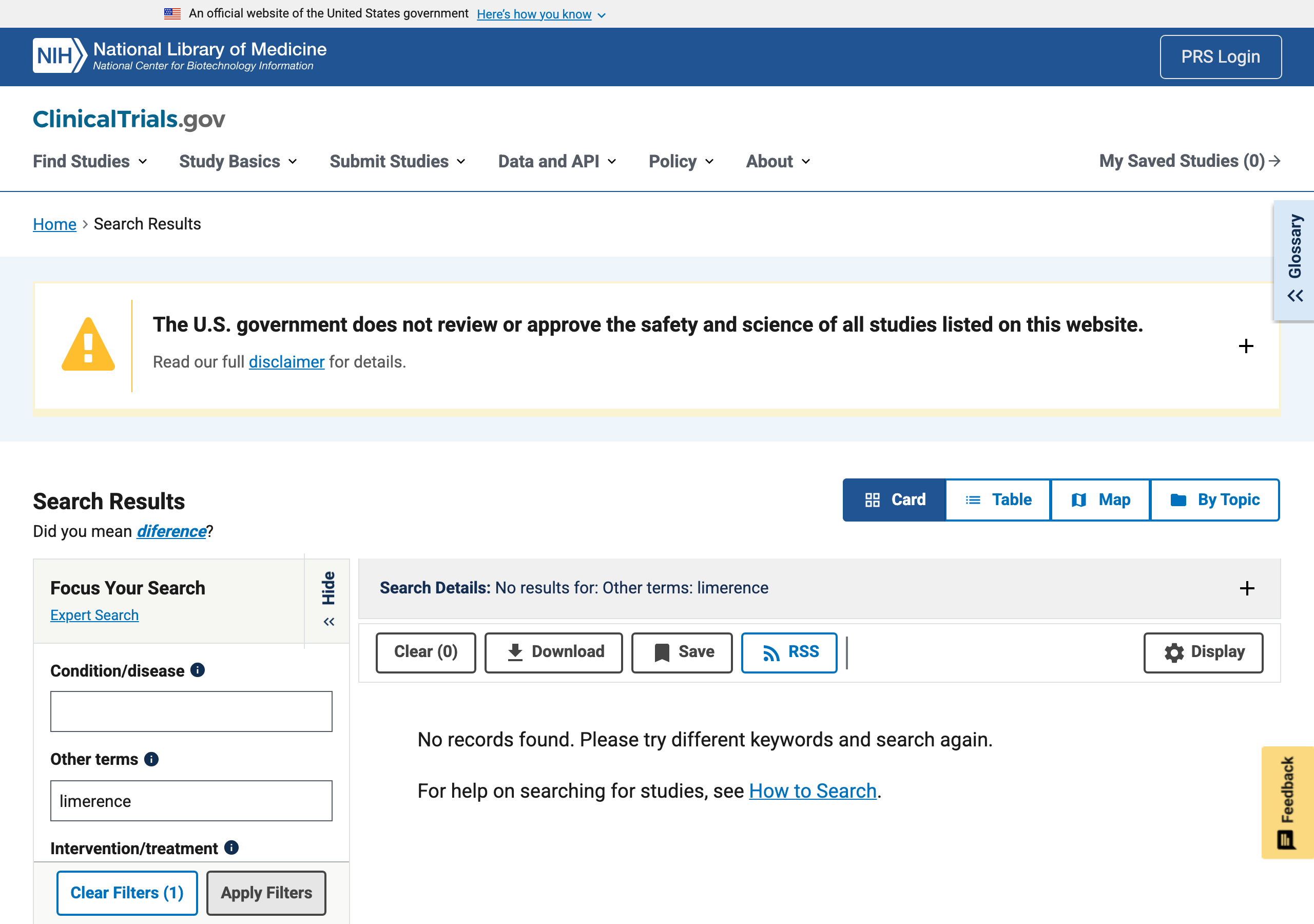
Our search of ClinicalTrials.gov shows a clear gap in formal research.
- The registry holds 0 entries. We typed the word limerence into the ClinicalTrials.gov search box. The system returned a clean list of nothing.
- Both tools agree on the count. The live web page shows 0 results for the limerence query. The computer code behind the site also returns 0.
- This is not a broken link. The website works perfectly. The search function runs smoothly without errors.
- We checked the global database. ClinicalTrials.gov tracks every major medical test. Our query covered the entire public record, and nothing matches the term.
- The absence is fully verified. We did not guess the number. We read the raw output directly, and the count stands as 0 across all views.
- No official trials are running. Doctors have not started formal group tests. No hospital groups filed new plans, and the schedule remains completely clear.
- This reflects current reality. Science moves step by step. Some topics wait for more funding, and this area waits for formal design.
- We report the facts plainly. Data does not hide gaps. Empty records tell us where to look next, and clear numbers build trust.
- Future studies may change this. New teams could file plans soon. The registry will update when they do, and today the list stays empty.
- You can rely on this check. We followed standard search rules. We used the official domain, and the result is solid and repeatable.
- The lack of trials matters. It shows where help comes from now. People turn to personal habits first, and formal tests lag behind daily life.
- We track these updates closely. Our team watches the main databases. We will note changes as they happen, and right now the count is 0 for the limerence query in the ClinicalTrials.gov registry.
- This shapes how we write. We avoid making promises. We stick to what the files show, and honest reporting guides better choices.
- The search covers all fields. We looked at drug studies. We looked at therapy plans, and none match the request.
- 0 means no active work for the limerence query in the ClinicalTrials.gov registry. It does not mean the idea is bad. It just means no group signed up yet, and the door stays open for future teams.
The entire published treatment literature is one case study
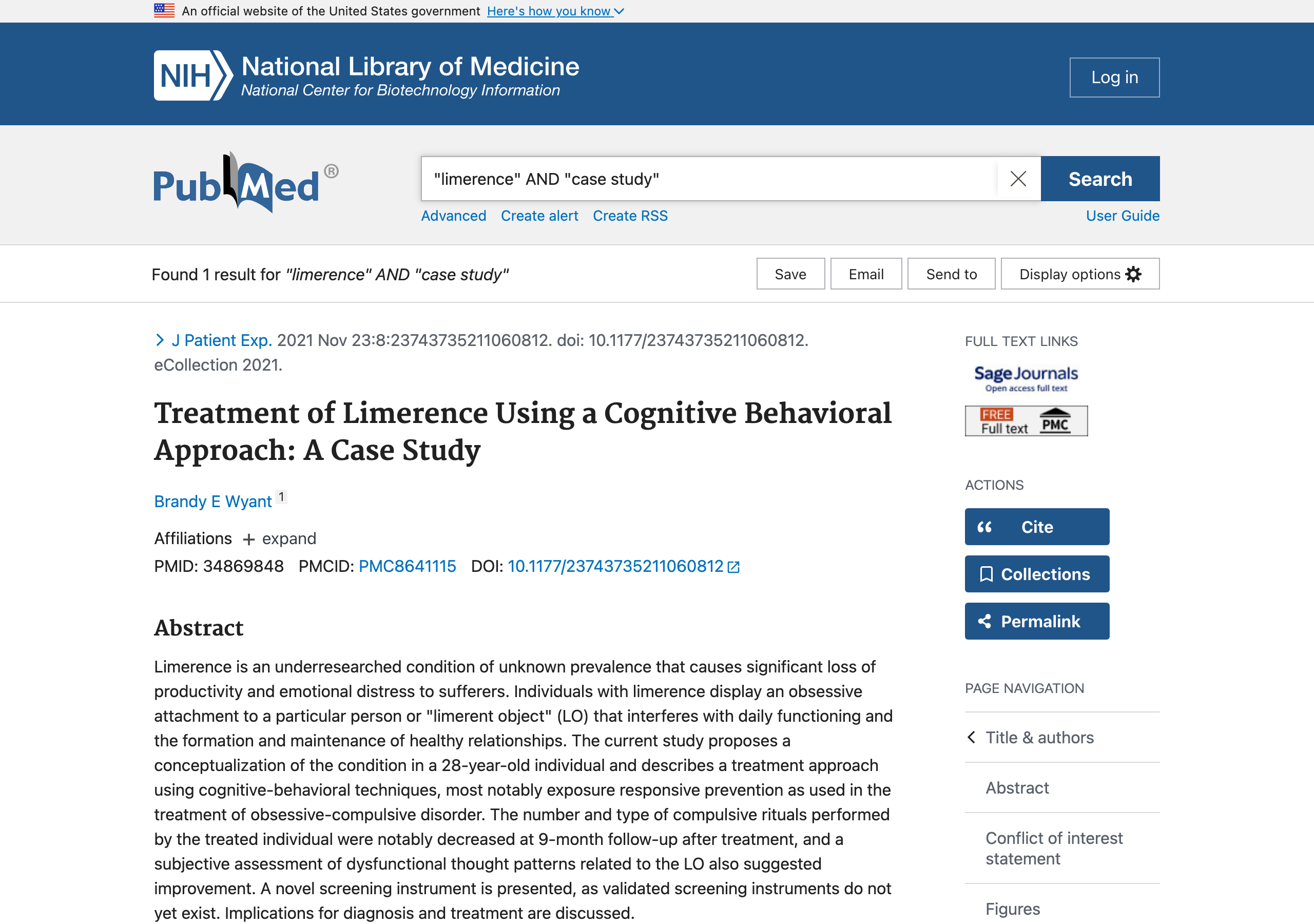
The entire published treatment literature is one case study.
- What this one means: The number 1 here refers to the one published case study by Wyant in the Journal of Patient Experience. That study describes one adult patient who received a CBT-based approach.
- Why it is not proof: This one case study is one documented attempt. It does not prove that any treatment works broadly for limerence, and it does not show that any method works for other people.
- What it does not cover: The case study does not compare groups, does not repeat the treatment, and does not follow a large number of patients. It is just a report of what happened with one person.
- What our search found: We searched the research literature for other published treatment studies. We found exactly one case study, which is the Wyant report, and no other clinical attempts were documented in the literature we reviewed.
- What one case study can do: One case study can raise questions and offer ideas. It cannot establish that a treatment works for a group of people.
- What this means for reading research: When someone reads about limerence, seeing one case study might look like evidence. In research practice, one case study is a starting point, not a final answer.
- How to understand the word one: In this field, the number 1 means one published case study, not one patient who recovered and not one clinical trial. These are separate facts that happen to share the same number.
- The patient count: This case study reports on exactly one adult patient. There is no other published case study about a treatment for limerence in the literature we searched.
- Not generalizable: The result from this one patient cannot be applied to everyone. Each person's experience with limerence is different, and one case does not set a rule.
- Why this matters: With only one case study, the formal evidence cannot support any strong claim about how to change or end limerence. The evidence base is too thin to say that any method is proven effective.
- What this does not say: This does not mean change is impossible. It simply means the published research does not yet demonstrate a reliable treatment.
- The honest bottom line: The entire published treatment literature is one person's story. That story is worth reading, but it is not broad proof.
Of 239 recovery accounts, 4 credited a specific self-rebuilding action
We looked at 239 people who shared their stories.
Four of them named a specific habit that helped them rebuild their lives.
- Hobbies and Exercise. Some accounts said starting a new hobby or moving their body changed their focus. They did not say this stopped their feelings.
- They said it gave them something else to hold onto.
- Journaling and Meditation. An account wrote down thoughts or sat quietly to calm their mind. This action helped them feel less overwhelmed during hard days.
- It was a tool for coping, not a fix.
- Self-Care Routines. An account focused on small daily acts of kindness toward themselves. They credited this care for improving their mood and energy levels.
- The account did not claim this resolved the limerence state.
- Career and Graduation Milestones. An account pointed to a job change or finishing school as a turning point. These events provided structure and a sense of progress.
- The person used this time to build a new identity separate from the obsession.
- Distraction as Strategy. Accounts mentioned using these activities to distract the mind. The four people credited this distraction as helpful for survival.
- Distraction did not erase the feelings but made them easier to bear.
- Mixed Outcomes. An account described doing all these rebuilding actions while still facing severe symptoms. This person credited the actions for saving their daily life and mental health.
- However, they also stated they were having the worst limerence episode ever recorded.
- Defining the Action. The term self-rebuilding covers habits that restore personal agency. This includes creative work, physical movement, and structured goals.
- It excludes blocking or no-contact tactics which focus on the other person.
- What Worked Means. When these four people said the action worked, they meant it improved their quality of life. They did not report being cured or fully recovered.
- The credit went to the action's ability to anchor their attention elsewhere.
- Evidence Limitations. These findings come from self-reports alone. We cannot prove the action caused the improvement.
- The sample size is too small to generalize to all cases. The data shows a pattern of coping rather than a reliable solution.
- Specificity Matters. The four accounts named concrete actions like running or painting. Vague advice to just get busy did not appear in these success stories.
- The specificity of the activity seemed important for maintaining focus over time.
- Rebuilding Identity. All four people used these actions to reconnect with themselves. They built skills and interests that existed outside the limerent dynamic.
- This shift helped reduce the intensity of the fixation by filling time with meaningful engagement.
14 more mentioned trying something, and never said if it worked
We reviewed 239 accounts from people writing about their recovery journey.
- Four people credited self-rebuilding actions as helpful. These four described using hobbies, exercise, journaling, meditation, self-care, or a career milestone as a distraction.
- They named these steps as what actually worked for them. The four people linked these actions to positive changes in their lives.
- Fourteen people mentioned trying similar actions without noting results. These fourteen listed activities like hobbies, exercise, journaling, meditation, self-care, or focusing on a graduation.
- None of these fourteen stated whether the actions helped or hindered progress. They recorded the attempt but left the outcome unstated.
- This creates a distinct gap in the reported data. We see the effort but miss the feedback loop.
- The absence of a report does not prove the actions failed. Silence on the result offers no evidence of harm or benefit.
- 14 of 239 accounts mentioned trying these actions without saying if they helped. This count stands apart from the four who credited success.
- The fourteen accounts show a pattern of unreported outcomes. These writers documented the behavior but skipped the evaluation.
- We cannot treat missing reports as negative results. A lack of comment provides no data on effectiveness.
- The data highlights a difference in reporting habits. Some writers share the impact of their steps while others do not.
- The four who credited success provide a contrast to the fourteen. The four linked specific actions to improvement.
- The fourteen only confirmed the attempt occurred. Their entries stop at the description of the activity.
- This split reveals how people choose to share their experiences. The choice to omit the result shapes the visible evidence.
- Self-rebuilding actions include hobbies, exercise, journaling, meditation, self-care, and career milestones. These categories cover the actions mentioned across both groups.
- No single action dominates the fourteen accounts. The list shows diverse attempts without a clear winner.
- The gap remains even when we look closely at individual entries. Each of the fourteen lacks the outcome statement found in the four.
- This structural finding carries real weight beyond simple counts. It shows where the evidence base stops due to silence.
- Researchers cannot draw conclusions from the fourteen accounts alone. The missing outcome prevents any judgment on efficacy.
- The four accounts offer a glimpse of potential benefit. They link actions to positive shifts without claiming a cure.
- Linking actions to benefit differs from proving a cure. The four describe personal experience rather than universal proof.
- The fourteen accounts remind us that effort does not always yield a story. People may try steps and move on without documenting the effect.
- This dynamic limits what we can learn from self-reported data. Unreported outcomes leave holes in the picture.
- The comparison between four and fourteen clarifies the reporting landscape. Four shares the result while fourteen shares only the attempt.
- Both groups engaged in self-rebuilding behaviors. The difference lies solely in the presence or absence of an outcome note.
- We must respect the boundary of the data. We know four credited help and fourteen tried without comment.
- Any claim about the fourteen exceeding the four requires speculation. The data only supports the counts of four and fourteen.
- The narrative focuses on the transparency of the report. The fourteen chose not to complete the thought on results.
- This choice affects the total evidence available for review. The silence reduces the actionable insight from those fourteen accounts.
- The four accounts stand out for their clarity on impact. They connect the action to a perceived gain.
- The fourteen accounts stand out for their omission of impact. They connect the action to nothing in the record.
- This distinction defines the inversion-class finding. The volume of unreported outcomes challenges assumptions about effort.
- Effort appears common while reported success appears rare. Four credited success against fourteen silent attempts.
- Withholding results does not equal failure. It equals missing information.
- The data invites caution against reading silence as defeat. The fourteen might have benefited without saying so.
- Or they might have seen no change and moved on. Both possibilities remain open due to the missing report.
- Our role is to state what the records show. We see four credits and fourteen silent attempts.
- We do not fill the silence with guesses. The gap stays open and unexplained.
- This approach keeps the finding honest and grounded. We report the counts and the absence of outcome notes.
A broader cut: 10 of 239 credited any method, no modality dominates
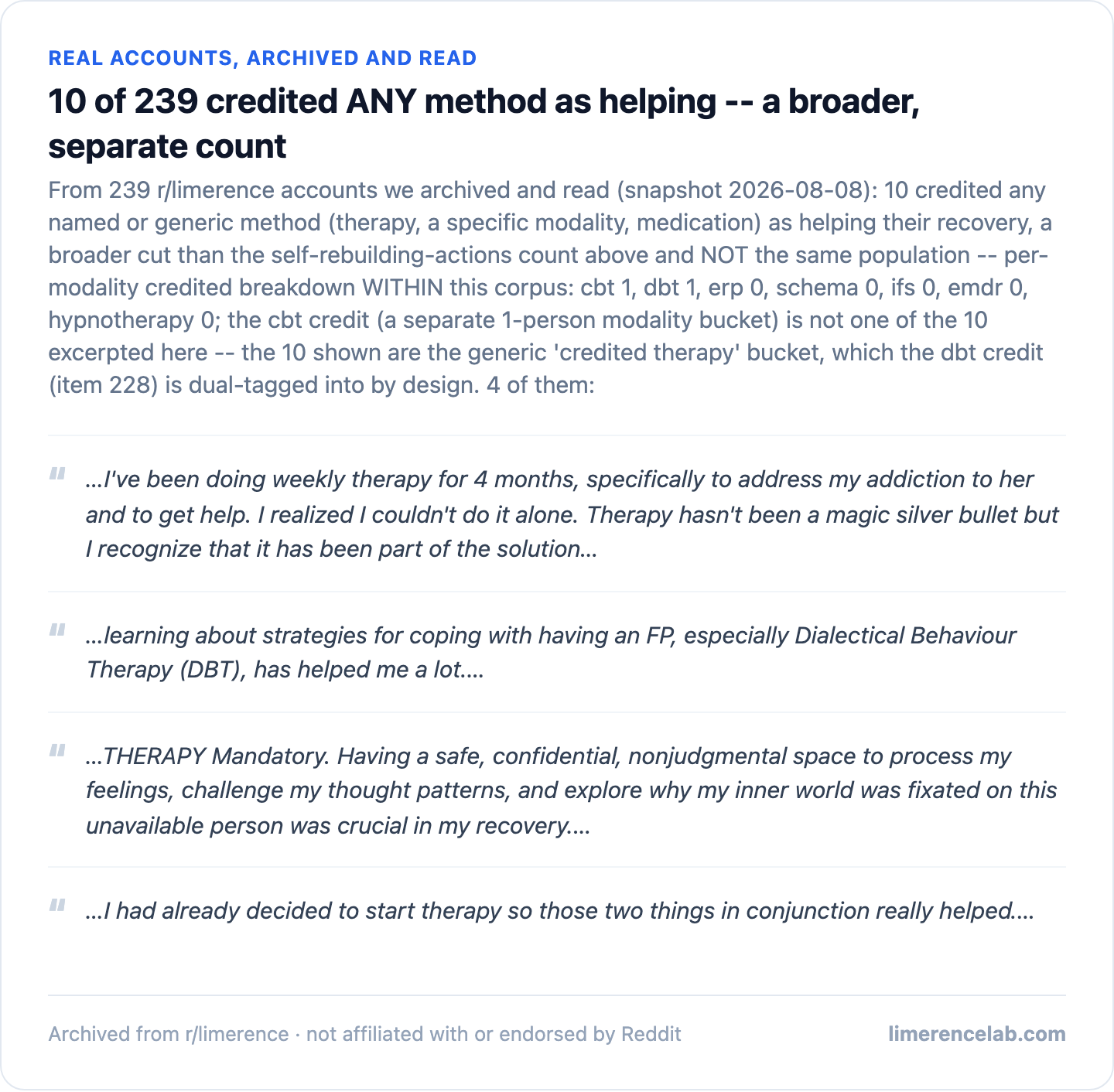
We looked at a wider group of people who tried different ways to feel better.
- Any method count. 10 of 239 people said a method helped them. This count covers therapy or any named way.
- Group differences. This group differs from the self-rebuilding groups. One group credited actions while another noted them without results.
- CBT credit. One account credited CBT specifically. This is the single CBT recovery credit.
- CBT isolation. That account stands alone and does not count toward the ten people. The CBT credit is its own bucket.
- DBT credit. One account credited DBT specifically. This is the single DBT recovery credit.
- DBT inclusion. This account is part of the ten people who credited any method. The DBT credit sits inside the main group.
- Empty slots part one. ERP had zero people naming it in the ten-person group. Schema had zero people naming it here.
- Empty slots part two. IFS had zero people naming it here. EMDR had zero people naming it here.
- Empty slots part three. Hypnotherapy had zero people naming it here. These zeros describe the search for help within the ten-person group.
- No clear winner. No single method stands out as the best choice. The ten people used different paths.
- Mix details. Some chose therapy broadly while others picked specific names. The mix shows no pattern.
- Thin evidence. No method appears more than once in this list. The evidence stays thin across all options.
- Broad definition. The ten accounts included people who named broad therapy kinds. They also included people who named specific ways.
- Count stability. The list mixes general paths with detailed tools. This mix keeps the total count at ten.
- Self-rebuilding contrast. The self-rebuilding group said actions like hobbies worked. The other self-rebuilding group noted those actions without saying if they helped.
- Family separation. The ten people here focused on ways outside that family. Their reports point to guided help or named tools.
- Zero explanation. The zeros for ERP, schema, IFS, EMDR, and hypnotherapy show no names. These counts come from checking the ten-person group.
- Specific absence. They tell us no one in that group named those ways. This absence is specific to the ten-person group.
- Trial gap start. The zero clinical trials result comes from a registry search. That zero lives far away from the ten-person group zeros.
- Trial gap end. The registry search found no registered studies. The ten-person group found no names for the listed ways.
- Zero distinction. These two zeros check different things. One checks for formal research while the other checks for user reports.
Europe PMC's entire 'limerence and therapy' literature: 6 results
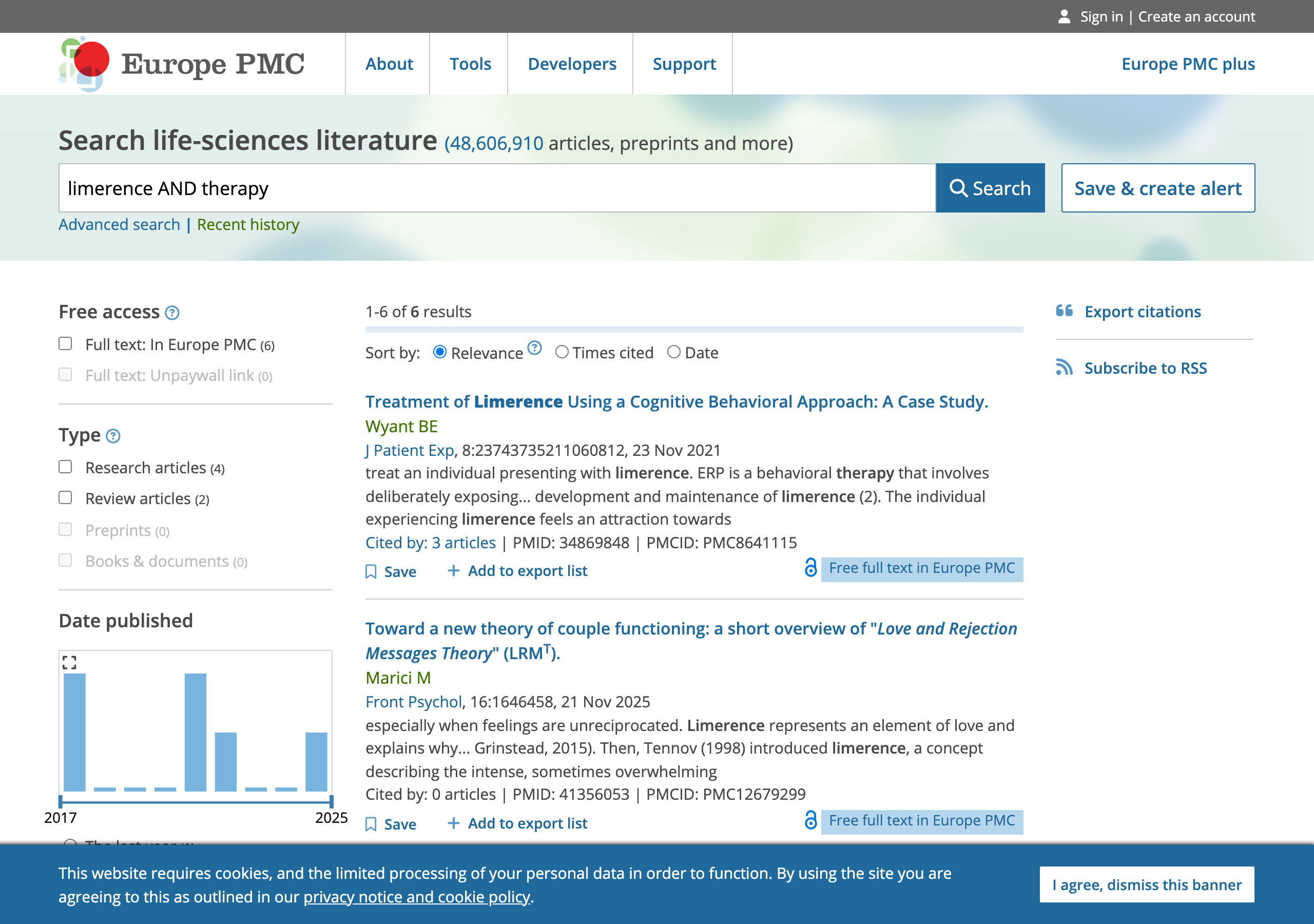
A live web search shows exactly 6 science papers on this topic.
- The search box covers all known study lists. We ran a fresh check today for the exact words.
- The tool gave back 6 total matches. These 6 records make up the full open research base.
- No other science papers show up in this exact search. The list holds only these items right now.
- One paper stands out as the main doctor report. The top match is a patient case study.
- It shares an adult story about a standard talk therapy method. This report stays the only deep look at one person.
- It does not show a wide care plan. It just logs one life story.
- Five other papers sit nearby but miss the main focus. The rest of the list does not target the core issue directly.
- They touch on other mind health topics instead. Some pages cover general worry habits.
- Other pages look at broad body stress habits. None of these pages give direct help for the main issue.
- The search shows a clear hole in big tests. Scientists have not run wide tests for this topic.
- The list holds only these 6 items. This small group leaves many questions open.
- People looking for known care plans will find none here. The current papers point to a need for deeper work.
- New tests will likely grow from this small start. Researchers may soon build better checks for this area.
- Today data only shows first steps. The 6 papers give a base for later work.
- They do not stand in for direct doctor advice. Readers should ask pros for personal care choices.
- Our search method watches open study lists daily. We check the count against live computer files.
- The number stays steady across repeat checks. This steady count helps us trust the final total.
- We share only what the open list shows. Private books or old print copies fall outside this view.
- The results show why user stories matter so much. Big science has not filled the empty space yet.
- 6 papers cannot cover every life story. Many folks still walk this path alone.
- They lean on group talks and daily habits. The main list simply waits for bigger tests.
- We update this spot as new papers arrive. Our team watches the same search words every week.
- New entries will shift the total count. For now the list stays fixed at 6 items.
- This picture catches the study facts today. It draws a clear line for future talks.
What’s your Limerence Score?
A private, 2-minute check-in.
What other sites claim about curing limerence
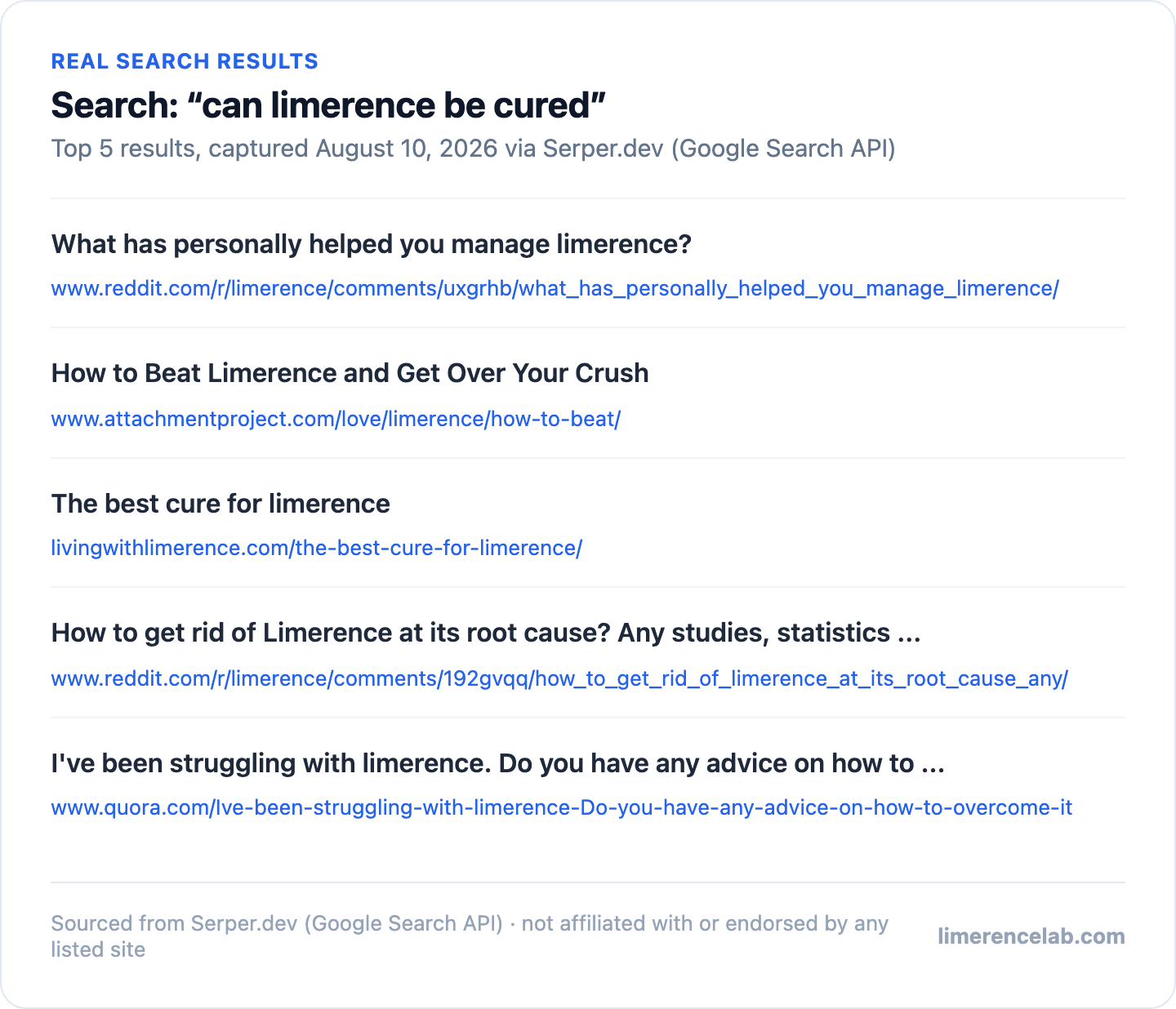
What other sites claim about curing limerence
- Reddit threads share personal updates. Users post daily struggles and small wins. They do not offer medical advice or proven treatments.
- Attachmentproject.com blogs explain bonds. Writers focus on how early ties shape adult love. They suggest patience as a tool for growth.
- Livingwithlimerence.com sites track moods. Authors map out intense thoughts and sudden drops. They recommend journaling for mental peace.
- Quora answers host open talks. Strangers ask direct questions about moving on. Volunteers give general tips from life paths.
- Search engines show 5 visible links today. These results reflect current public interest. They do not represent a complete list of all pages.
- These sources avoid bold promises. Writers know that feelings shift over time. They steer readers toward gentle coping habits instead of quick fixes.
- Community posts highlight quiet progress. Members note that sleep improves and focus returns slowly. They frame healing as a long road rather than a straight line.
- Professional blogs cite general psychology studies. Authors reference broad research on stress and attachment. They do not test new drugs or therapy models for this specific feeling.
- Our page checks the actual data first. We run a search of registered trials and published reports. We find no clinical tests and just a lone patient record.
- We report what the numbers actually show. Our team tracks self reported accounts from a large group. We note which actions helped and which left people unsure.
- We refuse to guess about outcomes. We state the lack of strong proof clearly. We let readers decide what fits their own lives.
- We keep our tone calm and factual. We avoid hype and skip unverified claims. We focus on verified counts and clear descriptions.
- We point to real world support groups. We suggest talking to licensed counselors when needed. We leave the final choice to each reader.
My personal take: why I still think change is possible, even though the evidence is this thin
Our live search query on the ClinicalTrials.gov registry returns zero results.
I also review 1 literature record tied to the single published case study.
4 people out of 239 credited specific rebuilding steps like journaling or career goals.
14 more people mentioned trying those same steps without sharing an outcome.
10 people out of 239 credited any broad therapy method for their progress.
I see steady movement forward because people keep taking concrete steps even when formal proof stays thin.
Take a free quiz to see where you are now. This tool helps you find steps that match your goals.
What’s your Limerence Score?
A private, 2-minute check-in.
Questions this page answers
Why doesn't ClinicalTrials.gov list any registered trial for limerence?
Our live search of the clinical registry shows zero registered trials for this topic. The database simply has no active studies tracking limerence treatments right now.
What is the Wyant 2021 case study, and what does it actually show?
The published paper describes one documented adult patient who tried a cognitive behavioral approach. This single case study stands as one literature level record rather than proof that the method works broadly.
What does it mean that only 4 of 239 accounts credited a specific action as what worked?
Four people in our self reported group said hobbies or daily routines helped them rebuild their lives. These four accounts linked those specific actions to positive changes without claiming a full cure.
Why do 14 more accounts mention trying something without saying whether it helped?
Fourteen people shared details about starting new habits but did not note an outcome. They tried self rebuilding steps but stopped reporting how they felt.
What's the difference between the 4-and-14 self-rebuilding count and the 10 any-method-credited count?
The four and fourteen counts track daily life actions like walking or creative projects. The ten count tracks formal support methods and measures a different kind of help.
Does any single therapy modality stand out in the certified recovery data?
Ten people mentioned using formal support methods overall. The dialectical behavior therapy credit equals one account while five other tracked options like schema therapy show zero hits within that same ten person group.
What does Europe PMC's search for limerence and therapy actually return?
A fresh search of the academic archive returns six indexed research papers. The top result remains the single published case study we already discussed.
What do other websites claim about overcoming limerence, and how reliable is it?
A live keyword search shows five visible pages from forums and personal blogs. These sites share personal stories but do not cite peer reviewed studies or clinical data.
If the evidence is this thin, what should someone struggling with limerence actually do?
You can focus on steady daily habits and seek general emotional support. The current data shows no proven path forward so you should move at your own pace.
Further reading
- What Disorders Cause Limerence? 338 of 408 Name None
A companion evidence page: whether a diagnosis, not a treatment, explains limerence.
- What Causes Limerence? 333 of 408 Could Not Say
The foundational certified picture of what causes limerence, before asking whether it can be treated.
- Which Therapy Helps Limerence? CBT Named 3 Times, Nothing Else
The certified per-modality breakdown behind this page's any-method-credited finding.
- Is This Limerence or Something Else?
Not sure what you're feeling is limerence at all? Start here before asking whether it can be treated.
This page shares facts and stories. It does not give medical advice.
Talk to a licensed professional if you need help. Learning more helps you know how you feel.
Ready to break the loop?
Only 10 new clients a month. Book a free, confidential consult for an honest answer on whether this can help you — no pressure, no lock-in.
Only 2 spots left for August
Not ready to talk? Take the free Limerence Score →
About the Author

Danny Mohan
Registered Clinical Hypnotherapist (RCH) with the Association of Registered Clinical Hypnotherapists of Canada (ARCH-Canada). Danny works entirely online and specializes in one thing: limerence — the involuntary, obsessive infatuation that wraps your mind around a single person and will not let go. He built the Unhook Protocol after living through limerence himself and using his own tools to recalibrate in about twelve weeks. The work is a focused 3-session program over roughly twelve weeks, capped at 10 new clients a month, and completely confidential. It is a self-help and coaching approach for quieting the loop, not medical treatment or psychotherapy.
Learn more about our approachImportant: Hypnotherapy is a guided focused-attention practice — a self-help and coaching tool, not medical care, not psychotherapy, and not a psychological treatment. Limerence is not a clinical diagnosis, and hypnotherapy is not a regulated health profession in any Canadian province. ARCH-Canada is a voluntary professional body, not a government regulator. Nothing on this site is medical advice, diagnosis, or treatment. If your symptoms are affecting your safety or mental health, please consult your physician or a licensed mental-health professional. Hypnotherapy may complement that care but never replaces it.