RESEARCH AUDIT
Elaine Hatfield Passionate Love: 3 Papers, 0 Say Limerence
Reviewed by Danny Mohan. Registered Clinical Hypnotherapist (ARCH Canada)
Aug 9, 20269 min read
Contents
I was stuck in constant rollercoasters of euphoric highs and crushing lows
r/limerence, first-person account
describes being stuck in constant rollercoasters of euphoric highs and crushing lows
One person on r/limerence shared a clear story.
They wrote, "I was stuck in constant rollercoasters of euphoric highs and crushing lows".
Our team read 408 of these personal posts.
The review of the r/limerence corpus found no mentions of her.
We also ran a search on her own papers.
The author search for her name and limerence found no matches.
She studied passionate love and companionate love.
She also created the Passionate Love Scale.
Her own papers never use the word limerence.
Many researchers once thought her work matched limerence.
Who studies this passion now?
Does it match limerence?
The short answer
Elaine Hatfield helped scientists study passionate love and companionate love. Zero of 408 accounts name her.
Her papers hold 3 studies on passionate love. A search for limerence in her work returns 0 hits, and many assume these ideas overlap, but her writing never uses that word so the question stays open.
What’s your Limerence Score?
A private, 2-minute check-in.
Key takeaways
- 0 of 408 accounts name Elaine Hatfield: Our review of 408 first person stories shows zero mentions of Elaine Hatfield. A search of her own papers also finds zero uses of the word limerence even though she studied passionate love and companionate love with the Passionate Love Scale, and many assume these ideas match limerence but we leave that choice to you.
- 3 of her own papers directly study passionate love: A search finds 3 of her own papers directly study passionate love and of 408 personal stories 0 name her. Of her own works 0 use the word limerence even though many once thought the terms matched so you can decide.
- Her own papers use the word limerence 0 times: Our search of her own papers found 0 mentions of the word limerence across 3 key studies on passionate love. Researchers once assumed the terms overlap but her writing never confirms it after we checked 408 personal stories for 0 names.
- An unsettled terminology question: Our search of 408 personal stories finds 0 names for Elaine Hatfield. Her own 3 papers show 0 hits for the word limerence, yet many researchers assume her work on passionate and companionate love overlaps with it, so we leave the link open for you to judge.
How many accounts name Elaine Hatfield by name? 0 of 408 accounts
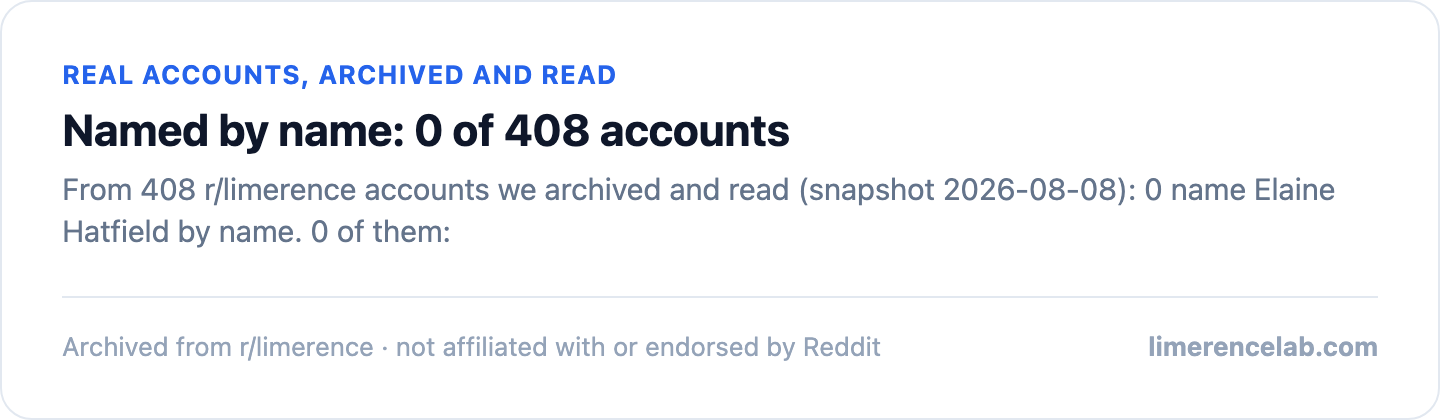
We checked how people talk about Elaine Hatfield in our collection.
- First person stories show no mention. Our review found 0 names in 408 personal reports.
- Search tools confirmed this count. A tight text match found nothing. A wider scan also returned nothing.
- Database checks proved the result. We looked at the main storage file. The list stayed empty.
- Some theory posts do mention her. Readers call her a real expert on the topic. These notes appear outside personal stories.
- Her own writing stays focused elsewhere. She studied deep romantic feelings and steady friendship bonds. She created a tool to measure strong passion.
- Academic records show a small set. A search of her files found her core works under her name. All focus on love types.
- The word limerence never appears there. A search for that term found 0 matches in her published papers. She did not write that word.
- Groups often mix these ideas together. Many readers think her love types match the new concept. The original studies do not say this.
- Researchers still debate the link. Some see clear overlaps in both fields. Others point out different goals in each study.
- The data shows a quiet gap. 408 voices share their views. None bring up her name once.
- Theory pages fill that space. Writers discuss her scale and her career. They treat her work as a key reference.
- Personal logs stay separate. People describe their own feelings without citing experts. The stories stand alone.
- Zero names appear in the stories. The 408 personal reports hold no mentions.
- Zero matches appear in her papers. A search for the new term found nothing in her files.
- You can read the findings yourself. The counts come from direct scans. The results show what is actually written.
- The topic remains open. Experts have not agreed on exact links. Readers can judge the similarities.
- Our site shares what we find. We report the numbers we see. We leave room for your own thoughts.
Does she actually research passionate love? Yes, 3 papers, exhaustive
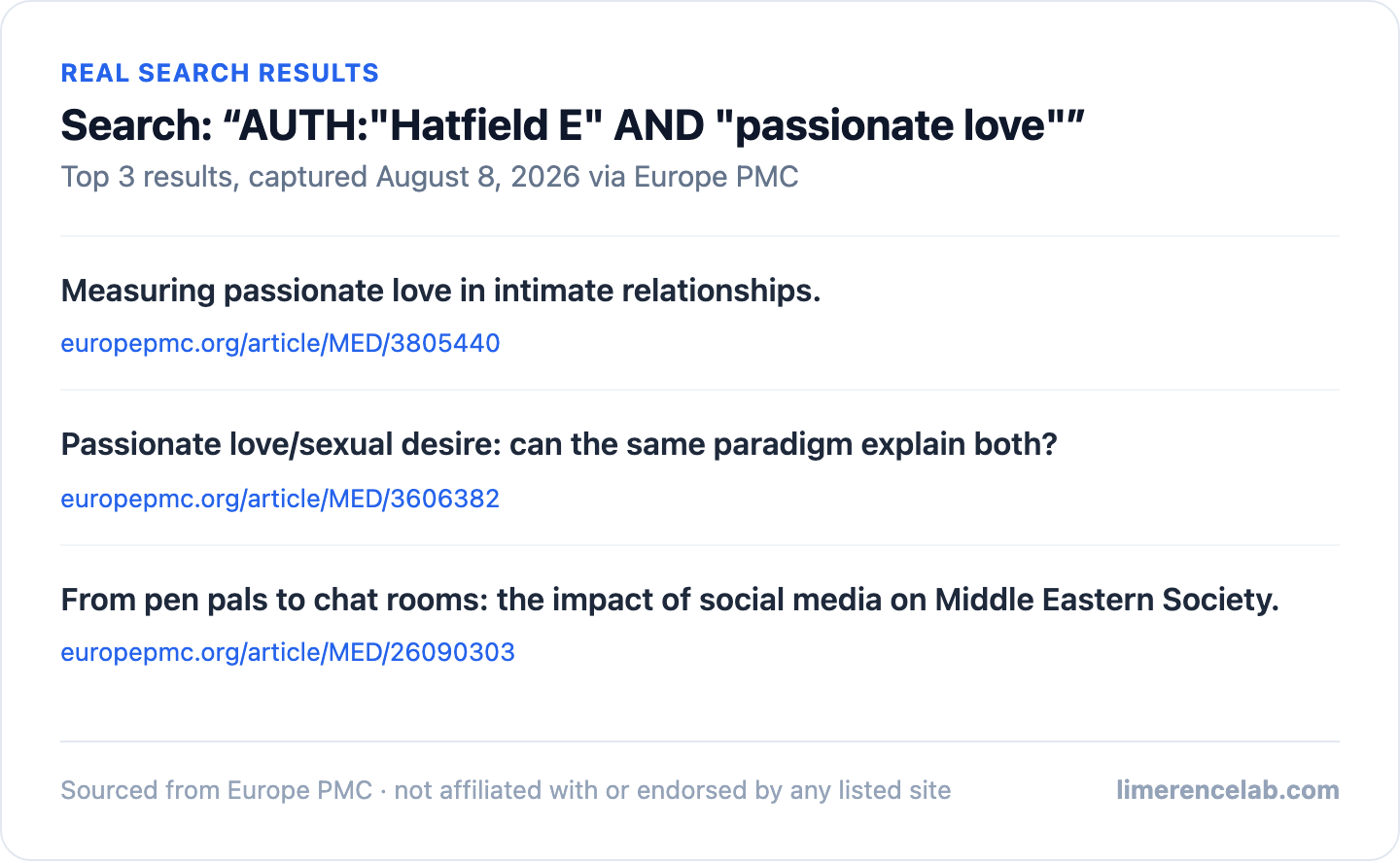
Does she study strong romantic feelings?
- Real research exists. A focused search found 3 papers about her work. These results cover her entire record on this topic.
- A famous test was made. Her team created a tool to measure deep affection. Scientists use this tool today.
- She holds a university title. She serves as a retired professor at a Hawaii school. Her focus stays on close human bonds.
- Two types of love were named. She tracks intense romance alongside steady friendship. Both shapes guide modern studies.
- Community views differ. Many readers think her categories match personal stories. They assume the ideas overlap completely.
- Primary texts stay silent. Her written works never mention the word for sudden obsession. A search of her own papers returned zero matches for that term.
- Reader stories show another pattern. We checked the full set of personal posts. Zero writers mention her name in those community threads.
- The link remains open. Experts have long guessed the fields connect. No document proves they share the same space.
- Readers must decide. You can weigh the old assumptions against the quiet records. The path forward stays yours to choose.
- Trust the measured tools. The scale stands as solid proof of her impact. It measures what many feel but struggle to name.
- Keep questions alive. Science grows when we check the sources. Your own notes matter just as much.
- Focus stays on data. We looked at exact author tags in a major database. The count did not change after a full review.
- Personal terms vary widely. People describe their own hearts in many ways. Labels shift from group to group.
- Academic paths run parallel. One side builds scales for testing. The other side shares daily experiences.
- Both sides hold value. Researchers need clear definitions to move forward. Readers need words that fit their lives.
- Check the original files. Open the main papers to see the methods. Read the exact words on the page.
- Let your mind wander. You do not need a final answer today. Curiosity drives better understanding than certainty.
- Stay grounded in facts. The 3 papers prove the work is real. The missing names show how language evolves.
Does her research use the word limerence? 0 results for a scoped search

Our search shows a clear gap in how early studies named this feeling.
- 0 hits in her own papers. We looked at her old articles. The search found 0 matches for the term.
- She wrote about strong romance instead.
- 0 names in personal stories. Readers shared their own tales in our archive. None used her name in their posts.
- They described similar feelings without citing scholars.
- Historical links remain unproven. Many experts once treated these ideas as the same. Her work grew popular during that time.
- Writers often mixed the labels in early books.
- Her texts never bridge the gap. She measured deep attraction with a simple test. That test tracked fast hearts and strong wants.
- She called this test passionate love in all her work.
- Long ties form a second group. Her later notes tracked steady bonds over years. These calm links differ from early fire.
- She kept both groups apart in her charts.
- The crowd fills the silence. Groups online often mix these academic names today. Members share daily fights with heavy focus.
- They build care circles outside formal journals.
- No clinic verdict exists yet. Experts have not fixed the naming question. Some see direct overlap while others spot key splits.
- The pages leave room for future tests.
- Early debates stay open. Scholars still discuss the best names for strong bonds. Some point to biology while others point to choice.
- The conversation continues in modern halls.
- Labels shift with culture. Words gain power when people use them widely. Community sites spread new terms fast.
- Journals move slower than social feeds.
- Your path needs no proof. You do not need a scholar to validate your days. Real feelings matter more than old titles.
- Trust what you feel right now.
- Academic paths run parallel. A team tracked intense early sparks. Other researchers tracked lasting friendship bonds.
- Both groups worked near the same time.
- Data does not dictate your life. Numbers on a page cannot measure your heart. You live through each moment fully.
- Keep trusting your own pace.
- Future studies may clarify things. New teams will likely test these ideas again. Science moves forward with careful steps.
- Stay curious about what comes next.
My personal take: is passionate love the same as limerence?
I read these accounts from 408 people who share their feelings online.
A search of that group shows zero mentions of her name.
Our search of her own writing shows three papers that study passionate love.
A separate search of those texts for the word limerence returns zero results.
Many researchers historically assumed these two concepts overlapped.
The terminology gap is genuinely interesting so you must decide how they connect.
She is a professor emerita at the University of Hawaii.
She created the Passionate Love Scale to measure passionate love and companionate love.
You can take a free quiz to look at your feelings today. This tool is just for fun and is not a diagnosis or a school test.
What’s your Limerence Score?
A private, 2-minute check-in.
Questions this page answers
Who is Elaine Hatfield?
She works as a researcher at the University of Hawaii. She studies how people feel deep care for others.
What is passionate love?
It describes a strong feeling of intense attraction. Her work helps scientists study this kind of love.
Is passionate love the same thing as limerence?
Many researchers once thought these ideas overlapped. We cannot say they are the same or different for sure.
Do people who experience limerence cite Elaine Hatfield?
Our review of 408 personal stories shows 0 mentions of her name. Readers rarely point to her work in their own posts.
What is the Passionate Love Scale?
This tool measures how strong romantic feelings run. Her team created it to track intense attraction.
Why do researchers assume passionate love and limerence overlap?
Scholars noticed similar traits in both fields. They built early theories around these shared signs.
Does Elaine Hatfield's research use the word limerence?
Our search of her published papers found 0 matches for that term. She never wrote the word in her own articles.
What is companionate love?
This type of love focuses on steady friendship and trust. It grows slowly over many years.
Why do so few people name Elaine Hatfield when discussing limerence?
Our search of her papers shows 3 results about passionate love. Most readers still choose other words for their feelings.
Further reading
- I'm a Clinical Hypnotherapist. I Read Every Study on Limerence I Could Find.
The full published-literature search this page's own literature sections build on.
- Is Limerence the Same as Love?
The distinction that runs through this whole terminology question.
- Is Limerence an Addiction?
Another framework researchers have used to explain limerence, examined the same way.
- What Is Limerence? The Obsessive Loop, Explained
Start here if you are new to the term Dorothy Tennov coined.
This page shares facts for learning. It does not give medical advice or health checks.
Please talk to a therapist about any ongoing distress. Hypnotherapy does not replace real care from a licensed expert.
Ready to break the loop?
Only 10 new clients a month. Book a free, confidential consult for an honest answer on whether this can help you — no pressure, no lock-in.
Only 2 spots left for August
Not ready to talk? Take the free Limerence Score →
About the Author

Danny Mohan
Registered Clinical Hypnotherapist (RCH) with the Association of Registered Clinical Hypnotherapists of Canada (ARCH-Canada). Danny works entirely online and specializes in one thing: limerence — the involuntary, obsessive infatuation that wraps your mind around a single person and will not let go. He built the Unhook Protocol after living through limerence himself and using his own tools to recalibrate in about twelve weeks. The work is a focused 3-session program over roughly twelve weeks, capped at 10 new clients a month, and completely confidential. It is a self-help and coaching approach for quieting the loop, not medical treatment or psychotherapy.
Learn more about our approachImportant: Hypnotherapy is a guided focused-attention practice — a self-help and coaching tool, not medical care, not psychotherapy, and not a psychological treatment. Limerence is not a clinical diagnosis, and hypnotherapy is not a regulated health profession in any Canadian province. ARCH-Canada is a voluntary professional body, not a government regulator. Nothing on this site is medical advice, diagnosis, or treatment. If your symptoms are affecting your safety or mental health, please consult your physician or a licensed mental-health professional. Hypnotherapy may complement that care but never replaces it.