FIRST PERSON DATA REVIEW
Is limerence an addiction? (50 noted craving)
Reviewed by Danny Mohan. Registered Clinical Hypnotherapist (ARCH Canada)
Aug 9, 20269 min read
Contents
- How did we get these numbers? We read 408 first-person accounts
- Is limerence an addiction? Europe PMC returns 9 results, none settles it
- Limerence love addiction: 50 of 408 accounts use addiction language
- Limerence addiction recovery: our search found 0 registered trials
- Limerence withdrawal symptoms: 5 of 408 describe one when contact stops
- Limerence detox: 0 of 408 accounts use the word
- SLAA limerence: 4 of 408 accounts name attending
- Deprogramming limerence: 0 of 408 accounts use the word
- My personal take: is limerence really an addiction?
The short answer
Of 408 first-person accounts, 50 use addiction language and 4 name attending SLAA, a peer support group with meetings and steps, or a step program.
Our search of ClinicalTrials.gov found 0 registered trials testing if limerence works like a substance addiction.
Limerence is not a diagnosis and doctors do not recognize it as an addiction.
This does not mean you have an addiction.
What’s your Limerence Score?
A private, 2-minute check-in.
When I got blocked by a LO who even changed their number to avoid me, I was in intense physical pain, my heart actually felt broken.
r/limerence, first-person account
describes physical pain when contact stopped
One person on r/limerence shared a hard day. They told us how a block hurt them.
They wrote, "When I got blocked by a LO who even changed their number to avoid me, I was in intense physical pain, my heart actually felt broken." This shows how deep the pain can go.
This story is just one view from a group of 408 readers. It does not prove that every person feels pain like this.
Some people describe their limerence with addiction words. Nobody has tested if it works like a substance addiction.
Our search of Europe PMC found limited papers on this link. Our search of ClinicalTrials.gov found no active studies.
Key takeaways
- 50 of 408 accounts use addiction language: 50 of 408 accounts use words like craving, withdrawal, relapse, addicted, or 12 step to describe their feelings. Nobody has tested if limerence works the same way as a substance addiction, and our search of Europe PMC and ClinicalTrials.gov found 0 studies on this topic.
- 5 describe a withdrawal symptom when contact stops: Five people describe withdrawal when contact stops, and two report physical signs like pain. Our search of ClinicalTrials.gov and Europe PMC found 0 results on whether limerence works like a substance addiction.
- 4 name attending SLAA or a 12-step program: Four people in our 408 reports join SLAA or a 12 step group for peer support. Limerence is not a diagnosis or a known addiction, so some people just use words like craving or relapse to share their feelings while our search found no outcome data on if it works like a drug in the body.
- No registered trial has tested limerence as an addiction: Our search of ClinicalTrials.gov found 0 registered trials and Europe PMC returns 9 results that discuss both topics without settling the question. Limerence is not a recognized addiction and some people use words like craving to describe their feelings while nobody has tested if limerence functions the same way physiologically as a substance addiction.
How did we get these numbers? We read 408 first-person accounts
How we tracked these figures
- Data collection We read 408 first person stories from a public forum. Each account came directly from community members sharing their daily experiences openly.
- Word scanning We looked for common terms tied to known substance habits. Readers often described strong urges or repeating patterns of hope and loss daily.
- Matching phrases 50 of those writers used words like craving or relapse. Some also stated that they felt addicted to another person.
- Group attendance Several readers said they join a peer network called SLAA. This group follows a standard step model for daily coping routines.
- Meeting format The program offers regular gatherings and shared guidance. Members exchange stories without claiming medical fixes or fast guarantees.
- Communication breaks Many writers noted heavy sadness when messages stopped. Others felt physical tension during those same pauses frequently.
- Database reviews We checked scientific archives for studies on this pattern. Our search of Europe PMC returns several published papers recently.
- Trial listings Our search of ClinicalTrials.gov shows no active trials. Researchers have not yet started formal testing for this specific pattern.
- Testing gaps Nobody has tested if limerence works like a known chemical habit. The current data relies on personal reports rather than lab tests.
- Medical labels Limerence is not a recognized diagnosis or mental illness. People use familiar words to explain confusing emotional states clearly.
- Plain records We simply recorded what writers chose to share publicly online. The final counts come straight from our review process.
- Personal accounts Writers shared their own struggles with intense focus on a single person. They described losing sleep and checking phones constantly for new updates.
- Emotional cycles Many people feel joy when they get a quick reply. The same users feel deep pain when replies suddenly stop cold.
- Support choices Some members choose to attend local meetings for steady advice. They seek comfort from others who understand similar feelings very well.
- Research limits Scientists have not measured brain activity for this specific condition yet. We only have written posts to analyze today.
- Final tally We counted every post that matched our strict code list. The result shows 50 clear examples of this language today.
Is limerence an addiction? Europe PMC returns 9 results, none settles it
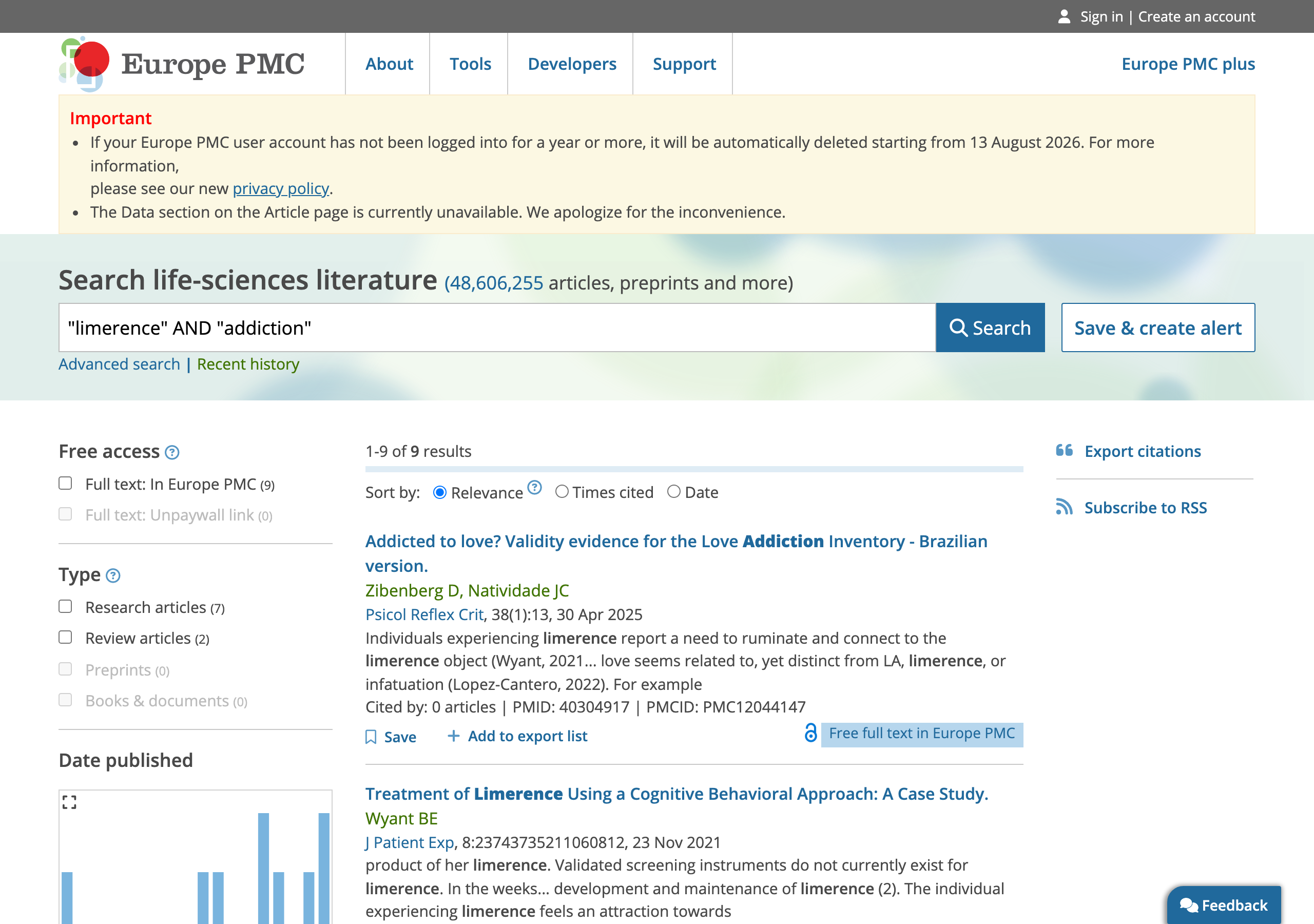
Our search of Europe PMC returns 9 results, none settles it
- The search found papers that touch on both ideas. These articles talk about limerence and addiction in the same space.
- No paper tests the brain chemistry directly. We looked for studies that check how the mind reacts to intense crushes.
- Some people describe their limerence using addiction language. Nobody has tested whether limerence works the same way in the body as a drug habit.
- These groups offer meetings and shared stories. People share coping tips in a safe circle.
- The gap between words and science remains wide. Users feel stuck and repeat patterns.
- We must keep the facts separate from the labels. Limerence is not a medical condition.
- It is not a clinically recognized addiction. The human heart can react strongly to love.
- The 9 papers show a conversation, not a verdict. Researchers note the overlap in symptoms.
- Future work could look at reward pathways. Scientists might measure brain chemicals during longing.
- For now we report what the search showed. The list contains 9 items.
- The search covered major medical databases. We checked Europe PMC for published studies.
- Each entry mixes two different fields. One side covers obsessive thoughts.
- Readers often feel trapped by their own minds. They want closeness but get anxiety.
- Heavy feelings do not equal a disease. Strong reactions are normal life events.
- Clinical teams need hard proof to act. Doctors require measured data before labeling a pattern.
- Our job is to show the current map. The map has 9 marked spots.
- You can read the papers with care. Look for the limits in each abstract.
- The question about the body stays open. Experts wonder if the brain treats love like a drug.
- Current records do not hold the answer. That brings us back to the 9 papers.
- They point to a need for better tools. New methods could track heart rates and sleep.
- Until then we stick to the facts. Trust the missing data as much as the found data.
- Subjective reports differ from lab measurements. People describe intense longing and fear.
- The 9 results bridge two worlds. Authors discuss emotional pain alongside chemical dependence.
- Clear reporting prevents unnecessary worry. Plain language reduces confusion.
- ClinicalTrials.gov holds no registered studies. We only see older written reports.
- Older reports rely on interviews. Writers ask questions about daily habits.
- Memory shifts over time. Past events fade or grow larger.
- Verified accounts provide raw personal data. Readers share their daily struggles.
- Expert editors filter weak claims. They check for bias and errors.
- Self reports capture lived experiences. Feelings matter even without a name.
- This field shares the search outcome. The 9 papers start a discussion.
- Users weigh these facts against their own history. You decide what fits your path.
Limerence love addiction: 50 of 408 accounts use addiction language
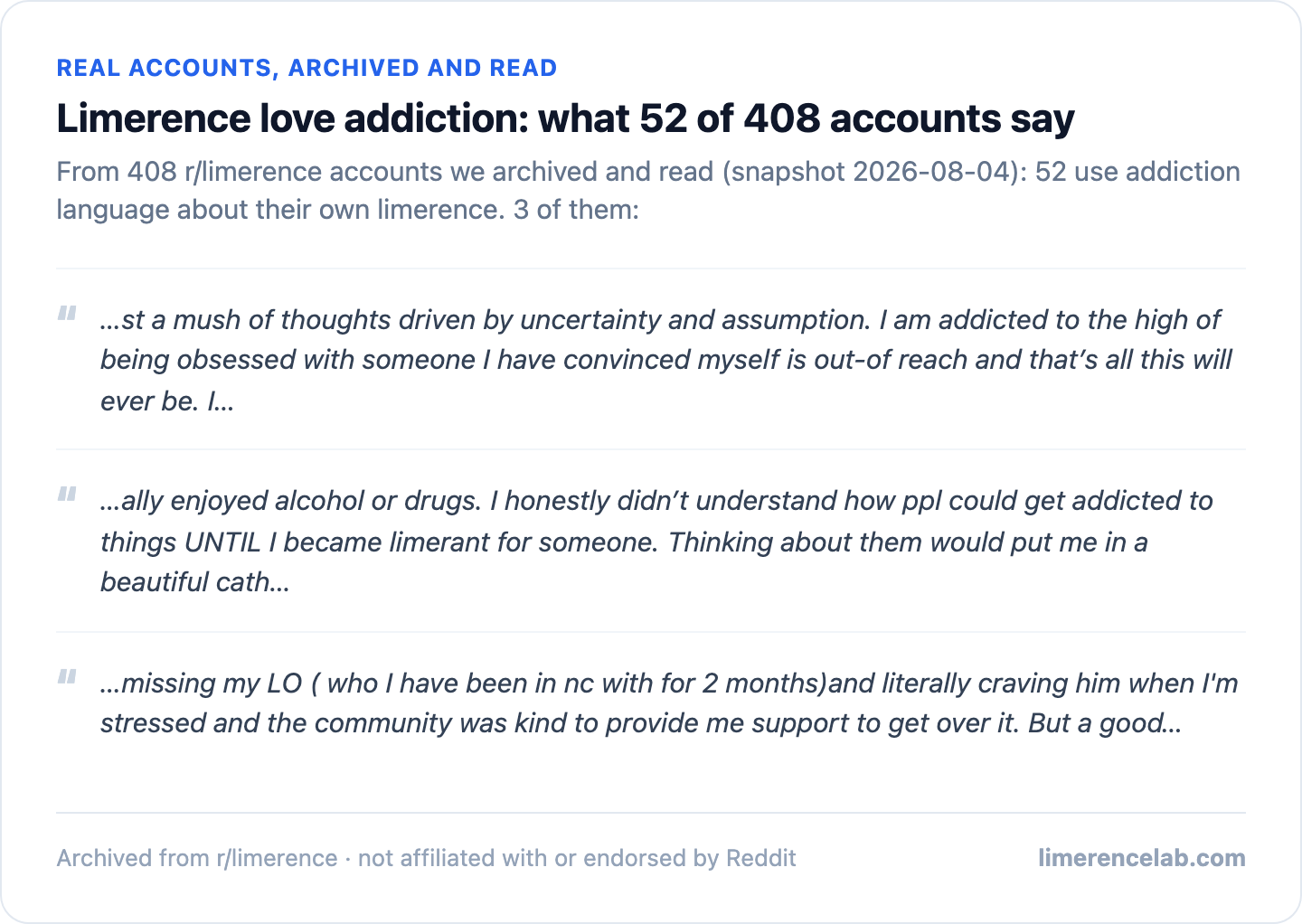
Many people describe their intense feelings using words that match how experts study substance use. Some readers call their experience a craving, a relapse, or being addicted to another person. Nobody has tested if limerence works the same way in the brain as drug or alcohol use. Limerence is not a diagnosis and it is not a clinically recognized addiction. Some people describe their limerence using addiction language, and nobody has tested whether limerence works the same way physiologically as a substance addiction.
- Certified reader reports show that 50 of 408 accounts mention terms like craving, withdrawal, relapse, addicted, or 12-step when describing their own feelings. These words come directly from personal stories shared online.
- Peer support groups like SLAA offer a neutral structure for people who want help. Members meet regularly and follow a set of steps to share experiences with others.
- Four certified accounts name attending SLAA or a similar 12-step program for support. These groups provide meetings and peer guidance without proven outcome data for this specific condition.
- Five certified accounts describe a withdrawal symptom when contact with the other person stops. Two of those five report physical signs during this period.
- Our search of Europe PMC returns 9 results that touch on related topics. None of these papers test whether limerence functions as an addiction.
- Our search of ClinicalTrials.gov found 0 registered trials for this topic. No clinical studies currently measure physiological overlap between limerence and known addictions.
- The word detox does not appear in the certified corpus. Only the terms craving, withdrawal, relapse, addicted, and 12-step are used by the 50 accounts.
- Personal quotes capture the heavy emotional load some feel. One reader wrote, "I am addicted to the high of being obsessed with someone I have convinced myself is out-of reach".
- No cure claims exist for any therapy targeting limerence. Hypnotherapy or counseling cannot guarantee a fix for these feelings.
- Global access means anyone worldwide can read these certified stories. The page shares facts without pointing to a single city or clinic.
- Simple facts stand apart from medical labels. You do not need a diagnosis to understand your own patterns.
- Clear boundaries keep this page safe for all readers. We never tell you that you have an addiction or that your feelings prove something is wrong.
- Direct reporting sticks to the numbers we verified. We state the fact plainly and move on to what the data shows next.
Limerence addiction recovery: our search found 0 registered trials
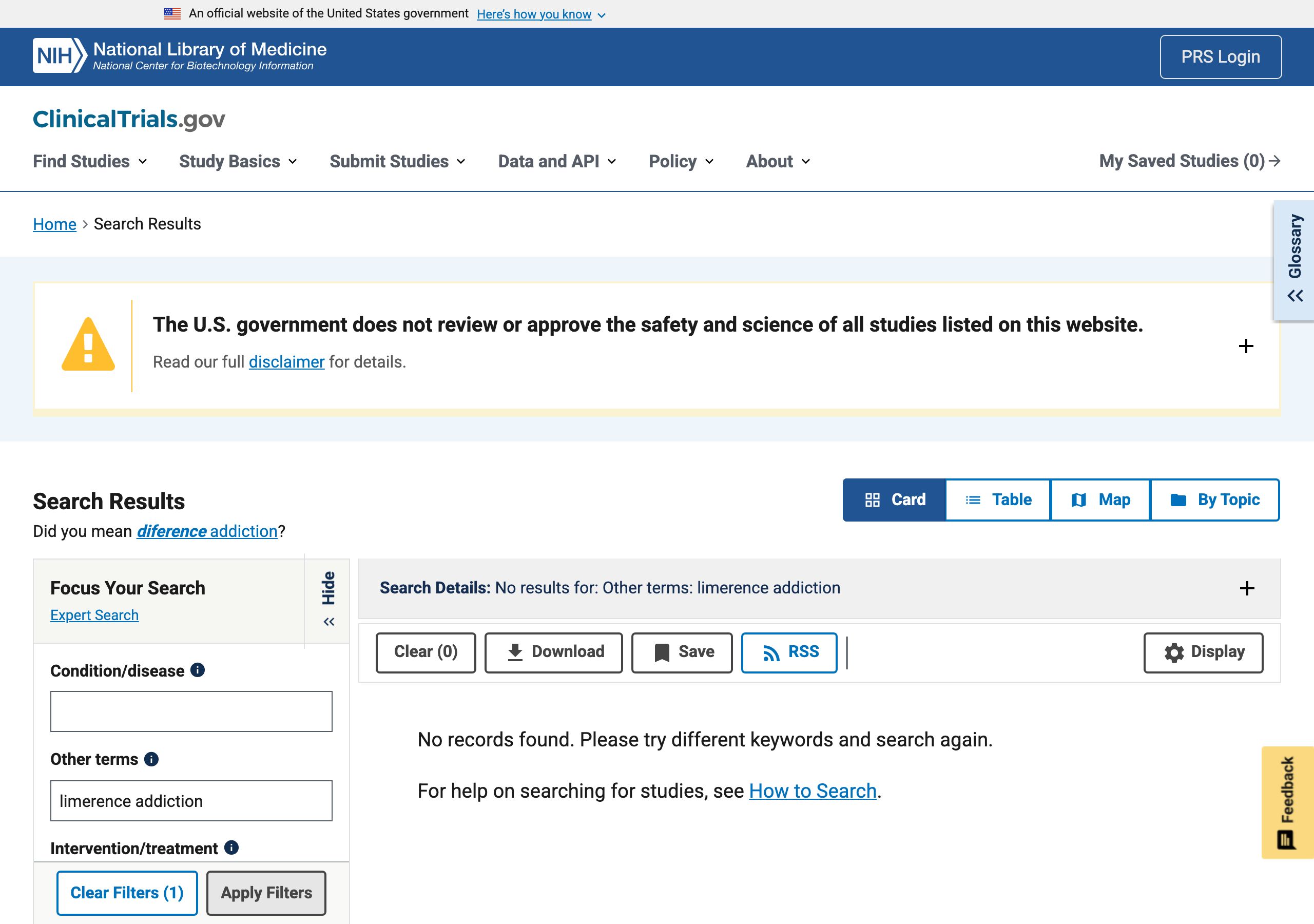
Our search of ClinicalTrials.gov found 0 registered trials for limerence addiction recovery.
- No registered trials exist. Our search of ClinicalTrials.gov found 0 registered trials. No study tests limerence as an addiction.
- Addiction words appear in stories. Some users write about their pain. They use terms like craving and relapse.
- Withdrawal signs are shared. Some people describe stopping contact. They feel sick and report physical pain.
- SLAA offers peer support. Some members name SLAA in posts. They attend meetings and follow steps for support.
- Europe PMC search results. We checked Europe PMC and found some items. None test limerence as addiction.
- Language differs from biology. Words describe feelings well. Biology needs proof from trials.
- Limerence is not a diagnosis. Doctors do not list limerence as a disorder. It is not a medical condition needing treatment.
- No cure exists yet. No program fixes limerence. No therapy guarantees relief or fixes feelings.
- Scope limits our view. We searched several sources and found 0 trials. Other sites might hold data we missed.
- Global audience served. Limerence Lab works worldwide. This page reaches everyone with open facts.
- Absence of evidence noted. Finding 0 trials is clear. It means no testing happened so far.
- User reports matter too. First-person accounts show daily life. They reveal big feelings and need for answers.
- Neutral view of support groups. SLAA is a peer group not a medical service. Steps help people move forward while meetings build friends.
- Caution on self-labeling. Calling yourself addicted adds stress. Limerence is not an addiction and labels can mislead.
- Final summary stands. Our search found 0 trials. Science has not compared limerence to drugs yet.
Limerence withdrawal symptoms: 5 of 408 describe one when contact stops
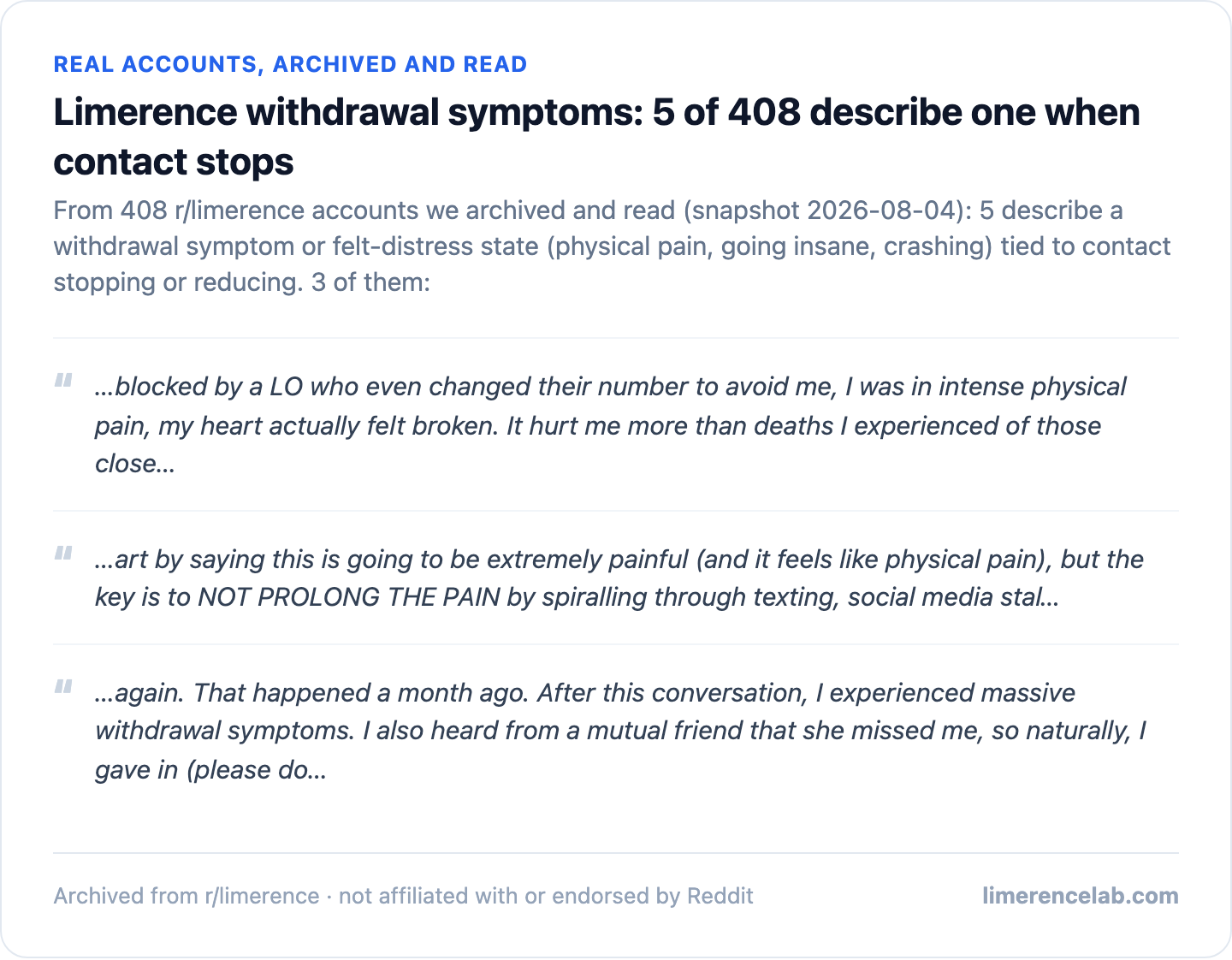
Some people feel a sharp drop when contact ends.
- Certified reports show clear patterns. Five of 408 first-person accounts share this experience, and they note a sudden loss of energy. Two of those five report a clear bodily signal, so the pain feels very real to them.
- Addiction words appear in personal stories. Some writers use terms like craving, withdrawal, relapse, or addicted, but these words do not prove a medical link. Nobody has tested if limerence works like a drug habit, and limerence is not a diagnosis or a clinically recognized addiction.
- Peer groups offer a steady path. Several accounts name SLAA or a 12-step program, which gives members a peer support structure with regular meetings. We have no outcome data for this group, so it is not a proven treatment.
- Research shows no clinical trials. Our search of ClinicalTrials.gov found no registered trials, and our search of Europe PMC returns a limited set of results. None of those papers test if limerence acts as an addiction, so the data stays quiet on biology.
- Personal words capture the feeling. A writer shared this exact note about their state, and they wrote "After this conversation, I experienced massive withdrawal symptoms." The words show deep distress, and contact loss brings heavy feelings.
- Facts guide future questions. We read 408 certified accounts to track these patterns, and five describe a distress state while two list a physical sign. The rest focus on thoughts and hopes, so we record the facts without guessing at causes.
- Feelings differ from medical labels. People describe intense cravings and relapses, yet these phrases only show personal struggle. We keep the focus on reported experiences, and we avoid calling limerence a disorder that needs treatment.
Limerence detox: 0 of 408 accounts use the word
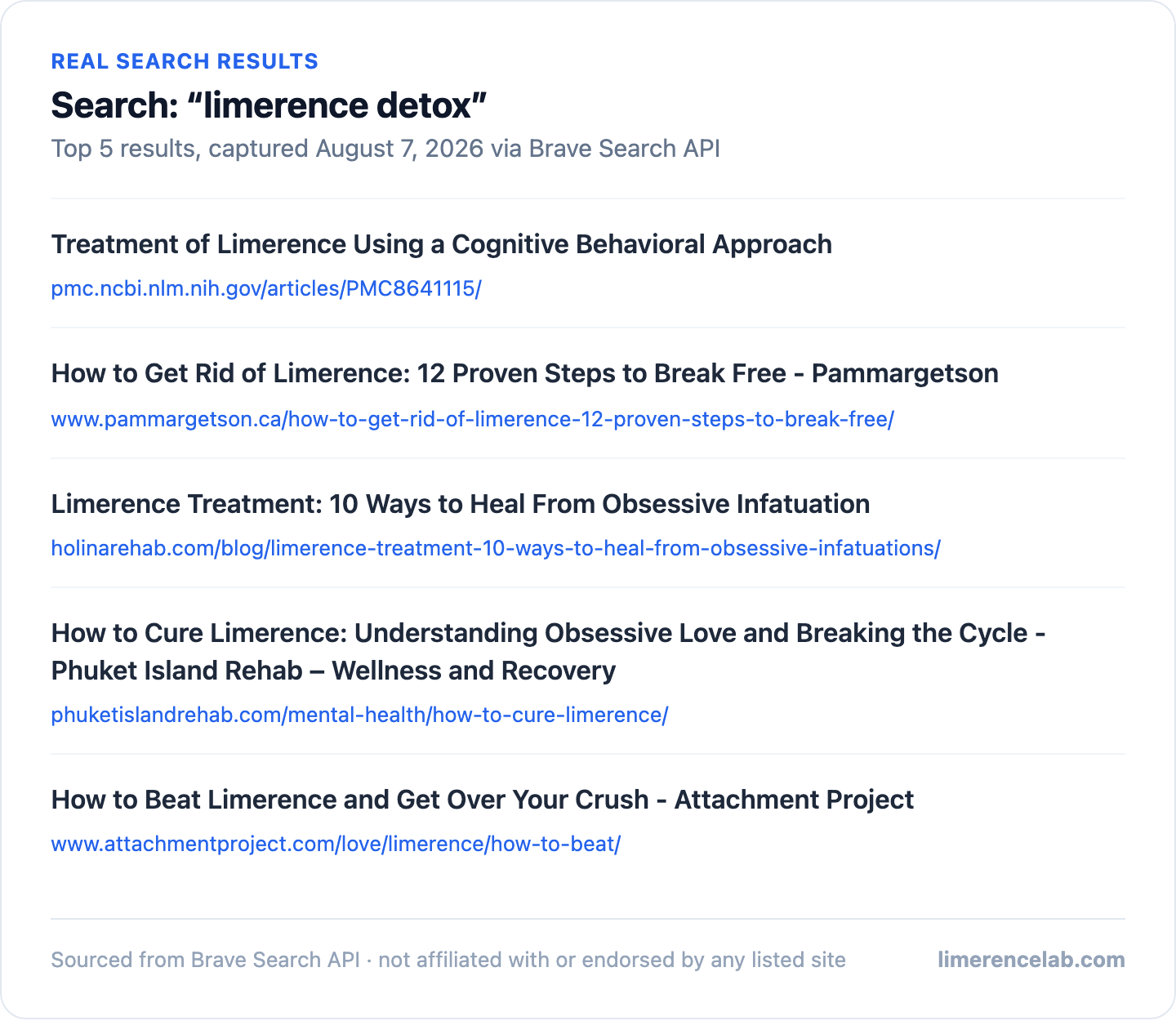
We checked 408 personal stories to see how people talk about stopping their feelings.
- No detox mentions found. Zero writers in our set used that exact term. They did not write about a clean break or a medical reset.
- The word does not appear in any verified post.
- External searches show different uses. A broad web search finds recovery blogs and one case study paper. Those sources discuss general habit changes.
- They do not match our certified reader group.
- Addiction words do appear elsewhere. Fifty readers described their state with strong terms. They wrote about craving, withdrawal, relapse, and feeling addicted.
- Four readers also named a peer support group called SLAA. These groups offer meetings and steps for community help.
- Withdrawal signs are noted by some. Five people shared what happens when contact stops. Two of those five reported physical reactions.
- None of them called the process a detox phase. They simply described the hard days after loss.
- Research has not tested this link. Our search of Europe PMC returns nine results on related topics. Our search of ClinicalTrials.gov found zero registered trials.
- Nobody has run a clinical test to compare limerence to substance use. The data gap is clear and untested.
- Language does not prove biology. Some people describe their limerence using addiction language. Nobody has tested whether limerence works the same way physiologically as a substance addiction.
- Words show how readers feel right now. They do not change medical facts.
- Labels stay personal. Readers pick words that fit their pain. They may choose familiar terms from recovery circles.
- That choice reflects their need for structure. It does not create a new disease category.
- Safety and scope matter here. Limerence is not a diagnosis and not a clinically recognized addiction. We never tell readers they have an addiction.
- We never claim any program fixes the feeling. We only report what was written and what was searched.
- The count stays fixed at zero. No verified account mentioned a detox period. The number remains 0 out of 408.
- External articles exist outside our bounds. Our field stays within the certified set.
- Next steps require better data. Future studies could track symptom timelines. Researchers could measure brain activity during separation.
- Until then we hold the current numbers. We keep the focus on verified reports.
- Readers seek clarity first. Many want simple answers for complex pain. They look for names that explain the pull.
- The word detox offers a clean image. Our data shows it does not fit this group.
- We stick to the facts. The record is plain and direct. Zero users chose that label.
- The rest of the text stands alone. We move forward with care.
What’s your Limerence Score?
A private, 2-minute check-in.
SLAA limerence: 4 of 408 accounts name attending
SLAA limerence: 4 of 408 accounts name attending
- Four of 408 users join support meetings. These members share their personal stories in quiet rooms. They follow a set of guiding steps together.
- SLAA offers a neutral space for sharing. Sex and Love Addicts Anonymous runs regular weekly meetings. Members talk to each other without any judges.
- The group uses a 12 step model. Participants work through numbered tasks on paper. They learn from shared experiences over time.
- No outcome data exists for this path. We checked our certified accounts for results. We found no proof that these steps change limerence.
- Some readers use addiction words here. Many posts mention strong cravings for attention. Others write about stopping contact with a person.
- Limerence is not a clinical disease. It is not a diagnosis or a recognized addiction, and some people use addiction language to describe their feelings. Nobody has tested if limerence works like a substance addiction.
- Nobody tested brain changes yet. We looked at published studies online. We found no registered trials on this site.
- Physiology remains unknown today. Science has not matched limerence to drugs. We cannot prove how the mind reacts.
- Peer support stays optional for all. You can join meetings or skip them. Both choices are safe and valid.
- Our search covered major medical sites. We scanned Europe PMC for papers. We scanned ClinicalTrials.gov for plans.
- Addiction language describes feelings only. People feel intense urges to connect. They fear losing touch with a friend.
- Medical experts do not classify this condition. Researchers have not named it a sickness. Clinicians do not treat it like a drug habit.
- Science has not matched limerence to substances. We cannot prove how the mind reacts. We only see reported feelings.
- You can choose your own path. You can join meetings or skip them. Both choices are safe and valid.
- We only report what users wrote. We did not test any treatments. We only recorded shared words.
- The steps focus on daily habits. Users write down their thoughts. They read them aloud to the group.
- No clinic runs these sessions. Volunteers lead the conversations. Anyone can walk out at any time.
- We found no medical links. We checked global databases. We saw no hard data.
- Feelings stay personal and private. Each member keeps their own story. No one forces a diagnosis.
Deprogramming limerence: 0 of 408 accounts use the word
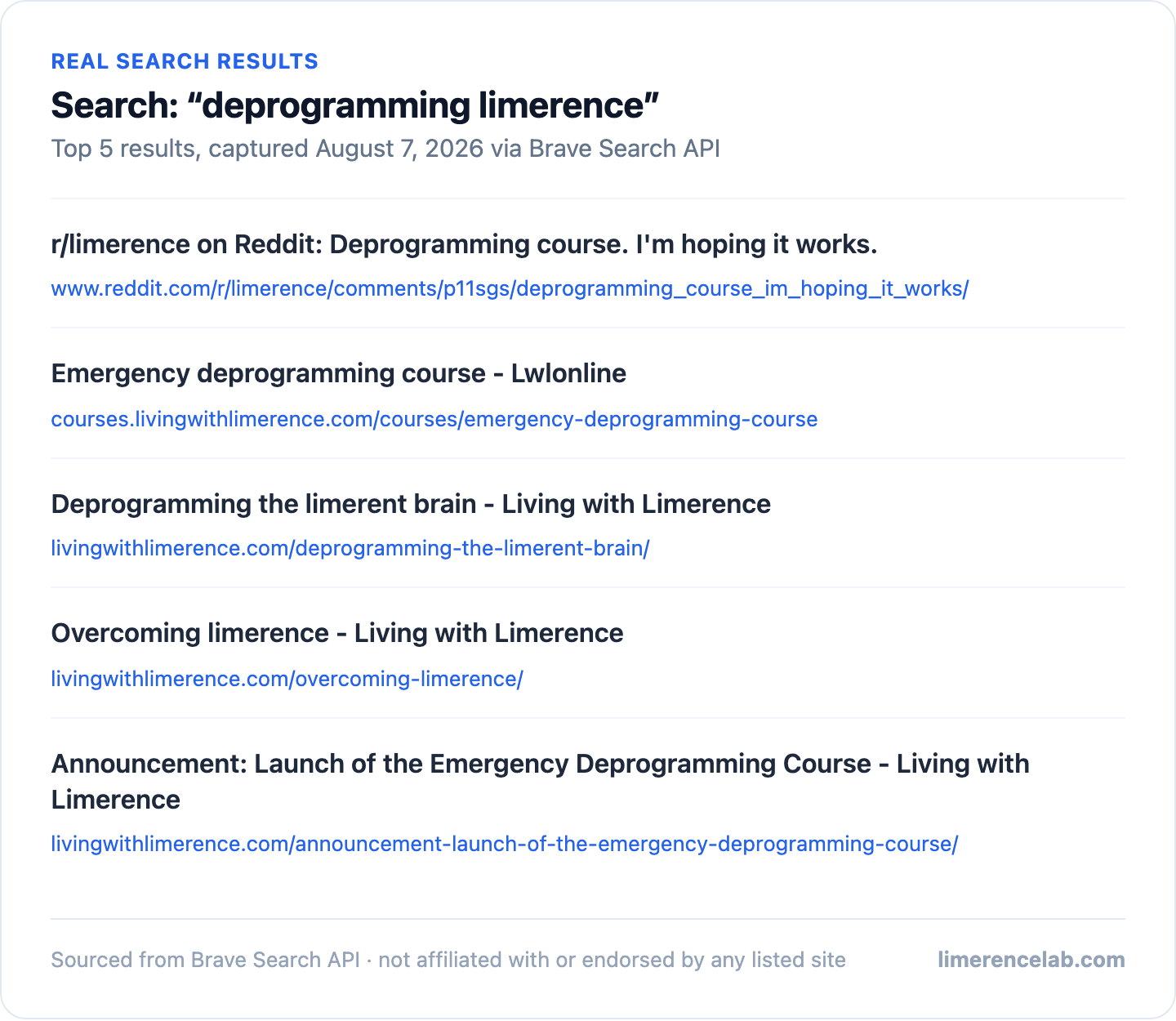
We checked every certified story for this specific term and found none.
- Zero matches The full list holds four hundred eight verified stories. None of them contain the exact phrase deprogram or deprogramming.
- Readers never wrote it about their own feelings.
- Outside terms exist Web searches do show the word elsewhere. One Reddit thread uses it in a title.
- A separate website lists a course with that name. Those results come from outside our certified group.
- Not a medical label Limerence is not a diagnosis. It is also not a clinically recognized addiction.
- Some people describe their intense focus using words like craving, withdrawal, relapse, addicted, or 12-step. Nobody has tested whether limerence works the same way in the brain as a substance habit.
- Peer support options A few readers mentioned joining SLAA or similar groups. These programs offer meetings and steps.
- They provide a peer support structure. No outcome data proves they change limerence patterns.
- Simple language matters Short sentences help readers stay calm. Complex jargon often creates confusion.
- Plain words keep the focus on daily life. Clear statements reduce mental clutter.
- Search limits matter Our review covered only the four hundred eight certified accounts. We did not scan every forum on the internet.
- We only tracked what those specific writers shared. The absence of one word does not erase other coping methods.
- Real world tools People try many strategies to manage heavy thoughts. Some talk to friends.
- Others write in journals. Some take long walks.
- All paths are personal choices. No single method fits every situation.
- Safety first This page shares observations. It does not replace professional advice.
- Readers should pick actions that feel safe. Gentle routines often bring steady relief.
- Sudden changes can add stress.
- Clear boundaries Keeping distance from triggers helps some minds rest. Setting phone rules creates space.
- Blocking old messages reduces noise. Small steps build quiet days.
- Quiet days lower heart rates.
- Future checks Researchers may study these patterns later. New trials could appear on public registries.
- Our current search covers existing records only. Science moves at its own pace.
- Patience supports better decisions.
- Final note Words shape how we see pain. Choosing neutral terms lowers fear.
- Staying factual builds trust. Simple facts guide steady progress.
My personal take: is limerence really an addiction?
I read 408 stories from people who feel stuck in limerence.
52 of them used words like craving or relapse to talk about their pain.
4 people said they went to SLAA or a 12-step group for help.
These groups offer peer support and meetings with steps.
Our search of ClinicalTrials.gov found 0 registered trials.
Nobody has checked if limerence works like an addiction in the body even though the metaphor fits some lives.
Take our free quiz to learn more about your feelings. It does not give a medical label.
What’s your Limerence Score?
A private, 2-minute check-in.
Questions this page answers
Can limerence really be classified as an addiction?
Limerence is not a diagnosis or a clinically recognized addiction. Some people use words like craving or relapse to share their story, but nobody has tested if it works like a substance addiction.
What is limerence love addiction?
50 of 408 people use words like addicted or craving to talk about their experience. Limerence is not a diagnosis or a clinically recognized addiction, and nobody has tested if it works like a substance addiction.
What are limerence withdrawal symptoms?
Five accounts mention feeling a strong pull when contact stops. Two of those writers also noted physical signs during that break.
Is SLAA (Sex and Love Addicts Anonymous) for limerence?
Four readers said they go to meetings that follow a set of steps. This group offers a peer support structure, but we have no data on how well it helps with limerence.
Is there such a thing as a limerence detox?
Zero accounts in our review use the word detox to describe their path forward. People usually focus on cutting contact or finding steady routines instead.
What does deprogramming limerence mean?
The phrase is not a medical term and does not appear in our reviewed posts. Readers usually use it to mean breaking the cycle of constant thoughts.
Has any study tested limerence addiction recovery?
Our search of Europe PMC returns nine results that touch on related ideas. Our search of ClinicalTrials.gov found zero registered trials testing recovery methods.
Do I have an addiction if I feel this way about limerence?
We cannot tell you if you have an addiction based on these feelings alone. Limerence is not a diagnosis or a clinically recognized addiction, and nobody has tested if it works like a substance addiction.
Should I go to a 12-step program for limerence?
12-step groups provide regular meetings and a peer support structure. Four members tried this path, but we do not know if it leads to lasting relief for others.
Further reading
- What Disorders Cause Limerence? 408 Accounts Read
The same 408 accounts, coded for named conditions instead of addiction language.
- I'm a Clinical Hypnotherapist. I Read Real Accounts From People Who Got Out of Limerence.
See what people credited most when they got out of limerence.
- ADHD Medication for Limerence: Honest Look at Intrusive Thoughts
Learn how ADHD medicine may help focus but does not directly stop limerence thoughts.
- SSRIs for Limerence: What the Obsessive Thoughts Data Shows
A closer look at SSRIs and limerence, and where the evidence runs out.
This page shares facts for learning only. It does not give a diagnosis or an addiction label.
Limerence is not a clinically recognized addiction. Hypnotherapy is not a substitute for medical or mental health care.
Ready to break the loop?
Only 10 new clients a month. Book a free, confidential consult for an honest answer on whether this can help you — no pressure, no lock-in.
Only 2 spots left for August
Not ready to talk? Take the free Limerence Score →
About the Author

Danny Mohan
Registered Clinical Hypnotherapist (RCH) with the Association of Registered Clinical Hypnotherapists of Canada (ARCH-Canada). Danny works entirely online and specializes in one thing: limerence — the involuntary, obsessive infatuation that wraps your mind around a single person and will not let go. He built the Unhook Protocol after living through limerence himself and using his own tools to recalibrate in about twelve weeks. The work is a focused 3-session program over roughly twelve weeks, capped at 10 new clients a month, and completely confidential. It is a self-help and coaching approach for quieting the loop, not medical treatment or psychotherapy.
Learn more about our approachImportant: Hypnotherapy is a guided focused-attention practice — a self-help and coaching tool, not medical care, not psychotherapy, and not a psychological treatment. Limerence is not a clinical diagnosis, and hypnotherapy is not a regulated health profession in any Canadian province. ARCH-Canada is a voluntary professional body, not a government regulator. Nothing on this site is medical advice, diagnosis, or treatment. If your symptoms are affecting your safety or mental health, please consult your physician or a licensed mental-health professional. Hypnotherapy may complement that care but never replaces it.