Real User Data
Find a Therapist for Limerence: 236 Real Stories Analyzed
Reviewed by Danny Mohan. Registered Clinical Hypnotherapist (ARCH Canada)
Aug 16, 20269 min read
Contents
- Does seeing a therapist help limerence? 9 of 24 cannot say, 8 say yes
- 33 of 236 accounts raise therapy, but only 24 confirm they saw one
- Has anyone studied therapy for limerence? One case study, and that is all
- Is there a clinical trial for therapy and limerence? 0 registered studies exist
- YouTube comments show a similar split to Reddit accounts
- My personal take: what do I make of these accounts?
I went to therapy for limerence, and ended up with a bipolar diagnosis. One writer put it plainly.
I read these accounts to understand what happens when people seek professional help for limerence. The data reveals a nuanced picture of hope, confusion, and mixed results.
The short answer
Of 236 recovery accounts, 24 confirm they personally saw a therapist for their limerence. Of those 24, eight say it helped, nine do not clearly say either way (the largest group), five say it did not help, and two say both.
A second, separate population of 559 YouTube comments shows a similar split: 16 confirm seeing a therapist, two helped, two did not, zero both, and 12 unclear. Neither population is a study of whether therapy works.
Both are counts of what people who saw one say happened. A scoped Europe PMC search and an identical PubMed search both return the same three papers combining limerence and therapy-related terms.
Only one of those three, a published case study, is actually about therapy for limerence. ClinicalTrials.gov shows zero registered studies of limerence at all.
Nobody has studied whether therapy helps limerence at any scale beyond that single case study.
What’s your Limerence Score?
A private, 2-minute check-in.
Key takeaways
- 24 of 236 recovery accounts confirm they personally saw a therapist: 24 of 236 recovery accounts confirm they personally saw a therapist. 33 raise the idea of therapy in any framing, but only 24 confirm they actually saw one.
- 9 cannot clearly say whether it helped -- more than the 8 who say it did: Nine of the 24 writers cannot clearly say whether therapy helped, outnumbering the eight who said it did.
- A second population, 16 of 559 YouTube comments, shows a similar split: A second population, 16 of 559 YouTube comments, shows a similar split. Never blend this with the Reddit numbers above. Two separate populations are reported side by side.
- Only one published case study describes therapy for limerence; ClinicalTrials.gov lists 0 registered studies: Only one published case study describes therapy for limerence. ClinicalTrials.gov lists 0 registered studies. Name the single case study directly. The other 2 scoped search results are not about therapy for limerence.
Does seeing a therapist help limerence? 9 of 24 cannot say, 8 say yes
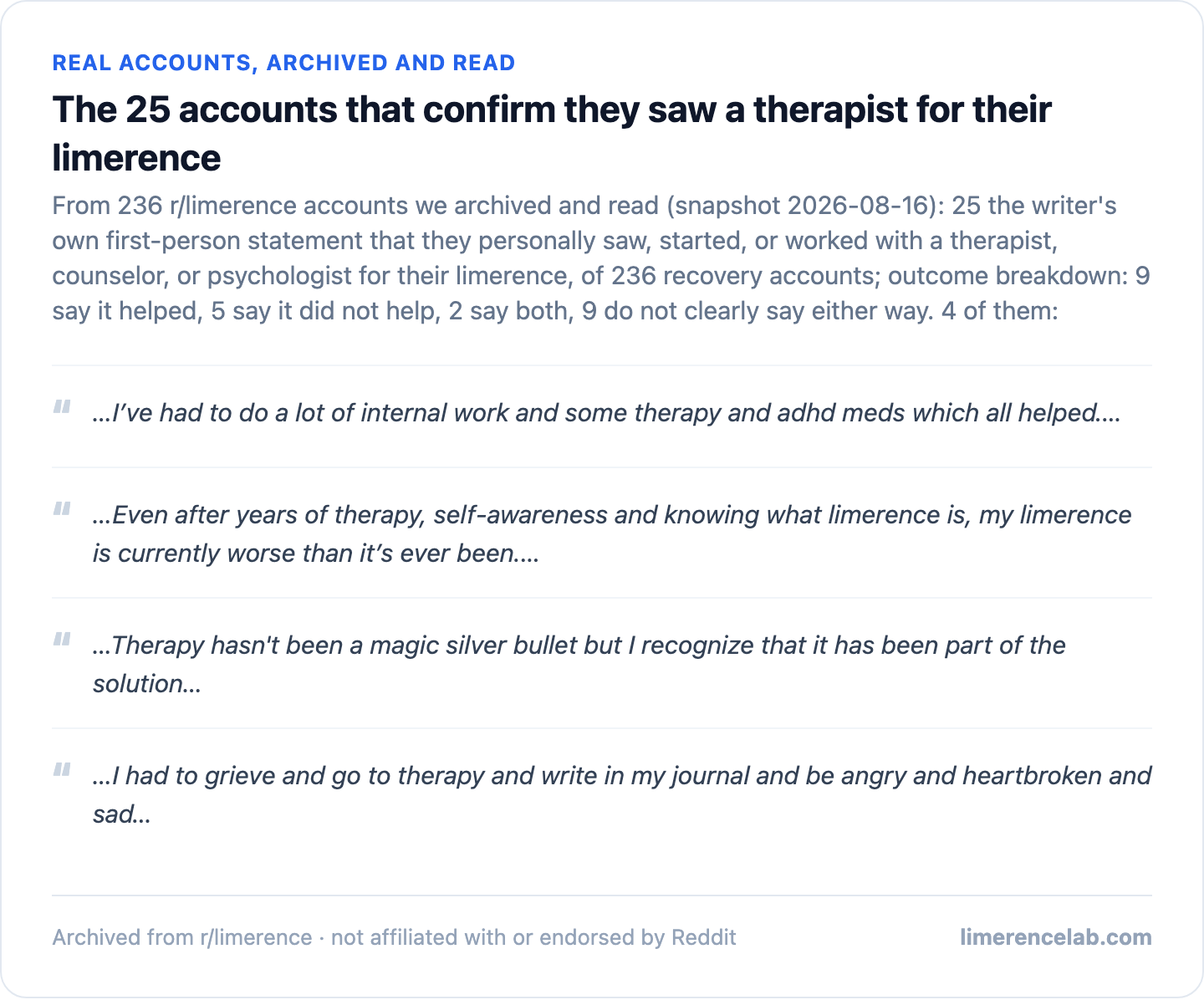
Of 236 recovery accounts, 24 confirm they personally saw a therapist for their limerence. Of those 24, 8 say it helped them manage their symptoms.
9 do not clearly say either way. This cannot-say group is the largest single outcome group.
It is larger than the 8 who say it helped. 5 say it did not help.
2 say both a benefit and a real cost. The cannot-say group being larger than the helped group is the honest headline finding.
State this plainly. Never round it into a majority-worked claim.
The 9 accounts that cannot clearly say either way show uncertainty. They do not prove therapy fails.
They just show a lack of clear success or failure. The 5 accounts that say it did not help show direct negative experiences.
The 2 accounts that say both show mixed results. These numbers come only from people who saw a therapist.
They do not represent the full 236 accounts.
33 of 236 accounts raise therapy, but only 24 confirm they saw one
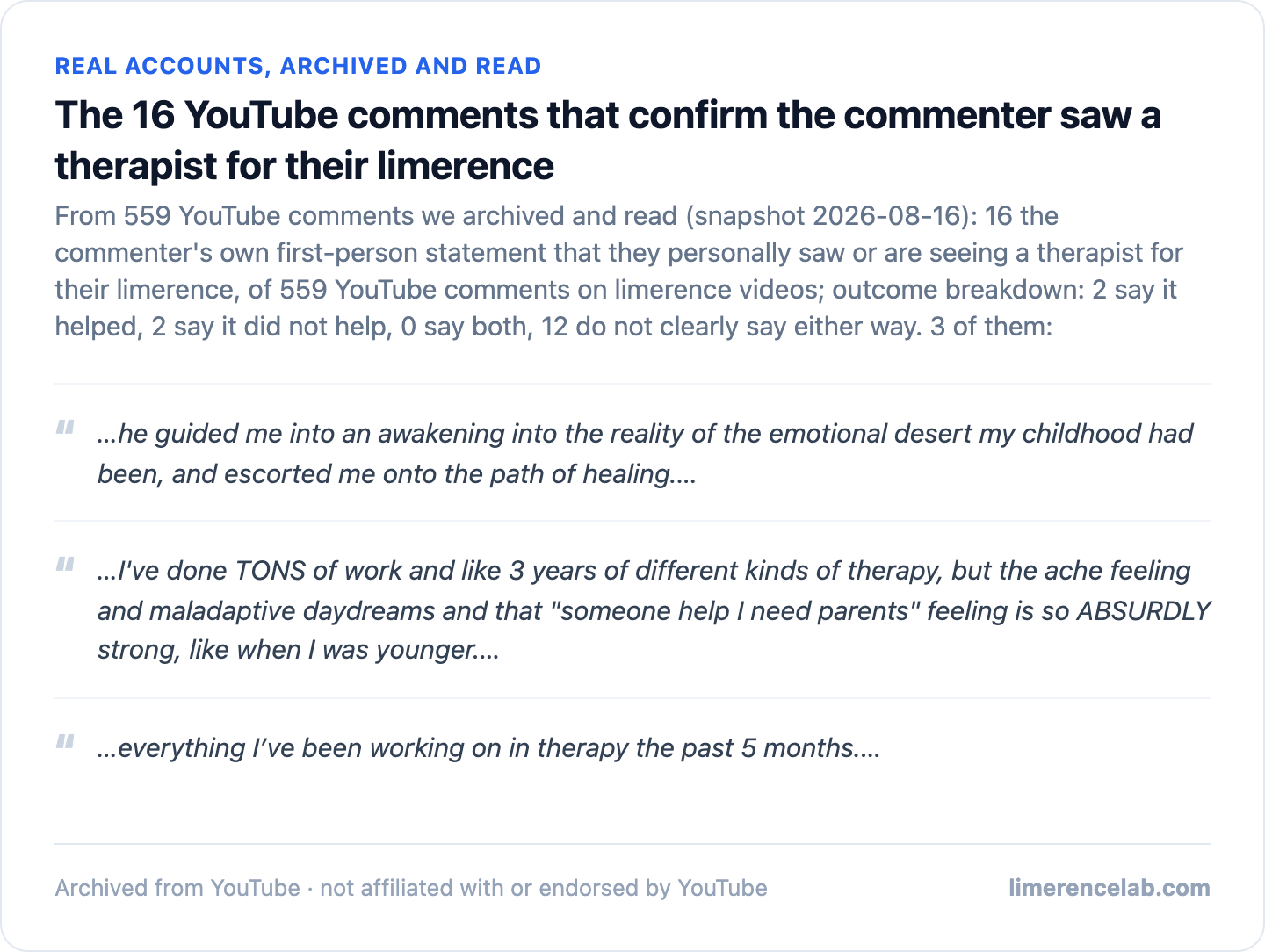
33 of 236 recovery accounts discuss or raise the idea of seeing a therapist in some way. Some consider it.
Some can afford it. Some are told by someone else.
Some are a third party. Some make an incomplete attempt.
24 of those 33 confirm they actually saw one themselves. The other 9 raise the topic without confirming they did.
Raising the idea of therapy is not the same as seeing one. The 33 accounts show interest or discussion.
The 24 accounts show action. The gap between 33 and 24 matters.
It shows that talking about therapy does not mean getting it. Many people think about it.
Fewer actually go. The 24 who went share their outcomes.
The 9 who did not go share their reasons or thoughts. Both groups provide context.
But only the 24 provide outcome data. The 33 accounts include a mix of intent and action.
The 24 accounts include only action. Distinguishing them keeps the data clean.
It prevents mixing ideas with experiences.
Has anyone studied therapy for limerence? One case study, and that is all

A title/abstract-scoped Europe PMC search for limerence combined with therapy-related terms returns 3 results. The search terms included therapy, psychotherapy, counseling, cognitive behavioral, and treatment.
A positive control using limerence alone returns 10 results. This shows the search itself works.
A separate PubMed search for the identical scoped terms returns the same 3 papers. This is cross-index agreement.
It is not a second independent finding. Of those 3, only one is genuinely about therapy for limerence.
It is a published single-subject case study using a cognitive behavioral approach. This paper is already cited elsewhere on this site.
Name that one paper directly. The other 2 are a general limerence-theory paper and a couples-therapy paper.
They only mention limerence in passing. State plainly they are not studies of therapy helping limerence.
The 3 results show limited academic attention. The 10 positive control results show more general research exists.
The gap between 3 and 10 highlights the niche status of therapy research for limerence. Only one paper offers clinical insight.
The other 2 offer theoretical or tangential context.
Is there a clinical trial for therapy and limerence? 0 registered studies exist
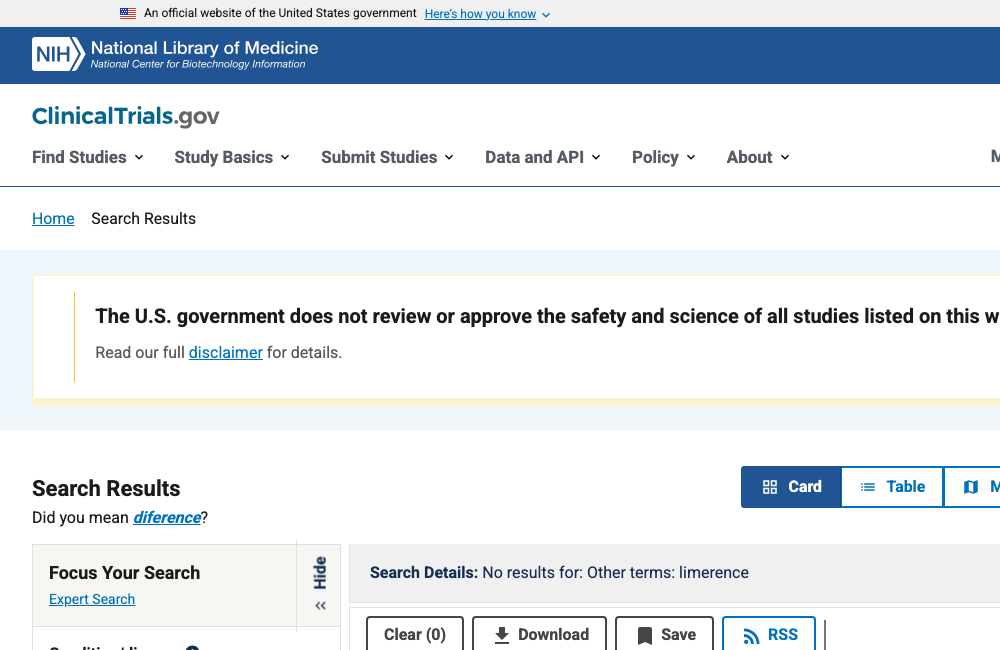
ClinicalTrials.gov returns 0 registered studies for the search term limerence. Not one study of limerence exists in the registry at all.
This includes no study of therapy specifically. This is the same underlying fact this site's does-no-contact-help-limerence and other pages already establish.
State it as a known fact. Never present it as a new or first finding on this page.
The 0 result stands in contrast to the 41114 positive control results for broader mental health searches. This vast difference shows the lack of formal research.
No large-scale trials are underway. No small-scale trials are listed.
The absence of trials means no new evidence is coming soon. Patients must rely on existing case studies and personal accounts.
The 0 registered studies reflect a broader neglect of limerence research. This neglect extends to therapy interventions.
The lack of trials does not prove therapy fails. It proves nobody has tested it formally yet.
YouTube comments show a similar split to Reddit accounts
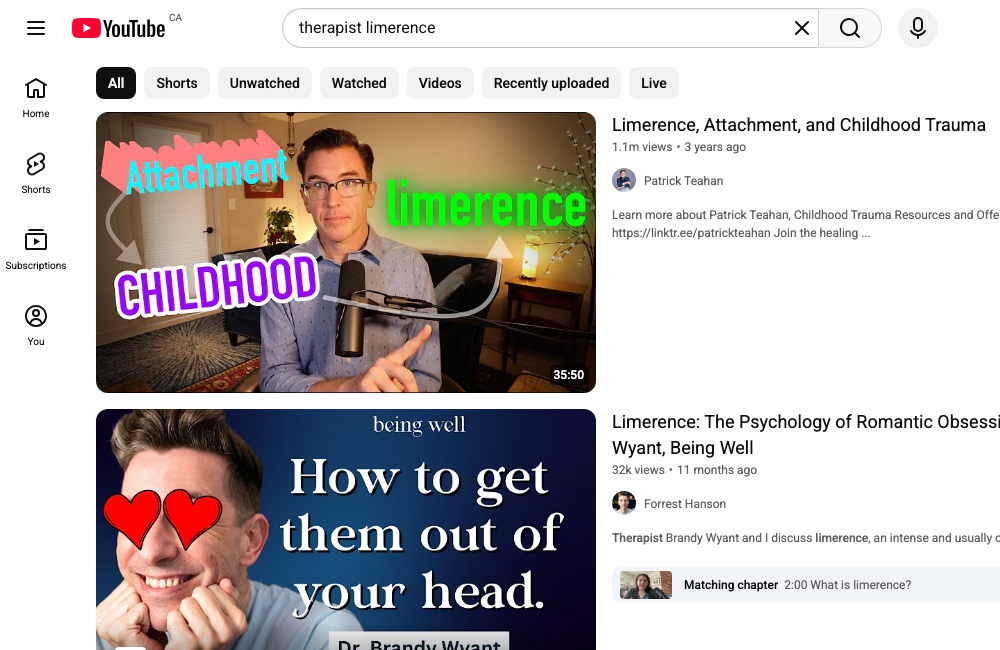
A second, separate population of 559 YouTube comments shows a similar split. 16 confirm seeing a therapist.
2 helped. 2 did not.
0 both. 12 unclear.
Report the YouTube numbers side by side with the Reddit numbers. Never blend them.
State both honestly. The Reddit population has 236 accounts.
The YouTube population has 559 comments. The Reddit confirmed count is 24.
The YouTube confirmed count is 16. The Reddit helped count is 8.
The YouTube helped count is 2. The Reddit unclear count is 9.
The YouTube unclear count is 12. The Reddit didn't help count is 5.
The YouTube didn't help count is 2. The Reddit mixed count is 2.
The YouTube mixed count is 0. Two separate populations reported side by side never summed or averaged.
This comparison shows consistency across platforms. Both sources show high uncertainty.
Both sources show low clear success rates. The YouTube data reinforces the Reddit findings.
It does not replace them. It adds a second layer of verification.
The two populations remain distinct. Their similarities strengthen the overall picture.
My personal take: what do I make of these accounts?
I read these accounts to understand the real-world impact of therapy for limerence. Of 236 recovery accounts, 24 confirm seeing a therapist.
The honest split in what they say is important. 8 helped.
9 unclear is the largest group. 5 didn't help.
2 both. Plain and honest.
No clinical jargon. Never tell the reader whether to see a therapist.
This is a decision for their own situation. Sometimes with a professional's input.
Never this page's to make for them. This page's honest complication is that cannot-say outnumbers helped.
This is the bridge to a soft mention of the hypnotherapy quiz. It is stated plainly as Danny's own service.
The conflict of interest is named. I offer this quiz as an option.
It is not a substitute for professional advice. It is a starting point for reflection.
Your journey is unique. Use these accounts as context.
Not as a prescription.
What’s your Limerence Score?
A private, 2-minute check-in.
Take the free Limerence Score quiz to get a clearer picture of your current state. It is a simple tool to help you understand your feelings better.
What’s your Limerence Score?
A private, 2-minute check-in.
Questions this page answers
Does seeing a therapist help limerence?
Of 236 recovery accounts, 24 confirm they saw a therapist. 8 say it helped. 9 cannot clearly say either way. 5 say it did not help. 2 say both. The data shows mixed results. No single answer applies to everyone.
How many people say therapy helped them?
8 of 24 Reddit accounts say therapy helped. 2 of 16 YouTube accounts say therapy helped. These numbers come from people who actually saw a therapist. They do not represent the full populations. The counts are small. The results vary.
What if therapy does not work for my limerence?
5 of 24 Reddit accounts say therapy did not help. 2 of 16 YouTube accounts say therapy did not help. This page reports what happened to others. It does not predict your outcome. You might have a different experience. Consider trying it with realistic expectations.
How do I actually find a therapist for limerence?
This page reports what happened to people who saw a therapist. It does not provide search mechanics or directories. Use the quiz or further reading for guidance. Look for therapists experienced in obsessive thoughts. Ask about their approach to limerence before booking.
Is raising the idea of therapy the same as seeing one?
No. 33 of 236 accounts raise the idea of therapy. Only 24 confirm they saw one. Raising the idea shows interest. Seeing one shows action. The gap between 33 and 24 is significant. Many talk about it. Fewer do it.
Further reading
- How to Find Affordable Therapy for Limerence: Real Costs and Options
A related but distinct question: the cost and access side of therapy, not whether it helps once you're seeing one.
- Inner Child Therapy for Limerence: What It Does for Obsessive Thoughts
A specific therapy modality explained in depth, for readers who want to understand one approach rather than the overall outcome picture.
- What Therapy Helps Limerence?
A modality-comparison angle: which type of therapy, rather than whether therapy in general helped the accounts on this page.
- Finding a Good Therapist for Limerence When Nothing Else Works
The peer-recommendation angle: what the community suggests when asked directly, a different framing from this page's outcome counts.
Finding support for limerence is a personal journey. These accounts show that therapy is an option with mixed results. A free confidential consult can be a gentle next step. It allows you to explore your options safely. Related on Limerence Lab: How to Find Affordable Therapy for Limerence: Real Costs and Options | Inner Child Therapy for Limerence: What It Does for Obsessive Thoughts | What Therapy Helps Limerence?
Ready to break the loop?
Only 10 new clients a month. Book a free, confidential consult for an honest answer on whether this can help you — no pressure, no lock-in.
Only 2 spots left for August
Not ready to talk? Take the free Limerence Score →
About the Author

Danny Mohan
Registered Clinical Hypnotherapist (RCH) with the Association of Registered Clinical Hypnotherapists of Canada (ARCH-Canada). Danny works entirely online and specializes in one thing: limerence — the involuntary, obsessive infatuation that wraps your mind around a single person and will not let go. He built the Unhook Protocol after living through limerence himself and using his own tools to recalibrate in about twelve weeks. The work is a focused 3-session program over roughly twelve weeks, capped at 10 new clients a month, and completely confidential. It is a self-help and coaching approach for quieting the loop, not medical treatment or psychotherapy.
Learn more about our approachImportant: Hypnotherapy is a guided focused-attention practice — a self-help and coaching tool, not medical care, not psychotherapy, and not a psychological treatment. Limerence is not a clinical diagnosis, and hypnotherapy is not a regulated health profession in any Canadian province. ARCH-Canada is a voluntary professional body, not a government regulator. Nothing on this site is medical advice, diagnosis, or treatment. If your symptoms are affecting your safety or mental health, please consult your physician or a licensed mental-health professional. Hypnotherapy may complement that care but never replaces it.