ENTITY CENSUS
Sandra Langeslag Love Regulation: 4 Papers Found
Reviewed by Danny Mohan. Registered Clinical Hypnotherapist (ARCH Canada)
Aug 9, 20269 min read
Contents
I often end up being unsuccessful in staying in a safe place of emotional regulation
r/limerence, first-person account
describes often being unsuccessful at staying in a safe place of emotional regulation
A person on r/limerence described their daily struggle.
They shared a clear truth about their mind.
"I often end up being unsuccessful in staying in a safe place of emotional regulation"
Many of the 408 readers feel the same heavy pull.
They want calm but find it hard to hold.
Who actually studies how to calm these strong love feelings?
Does the work match what readers seek?
The short answer
Sandra Langeslag studies how people regulate their romantic love feelings, down regulation after a split, and cognitive reappraisal strategies. Our search of 408 personal stories shows zero writers mention her by name.
Our search of her papers finds exactly four studies on managing these feelings. Our search for her name and the word limerence returns zero hits because she never uses that term in her work.
What’s your Limerence Score?
A private, 2-minute check-in.
Key takeaways
- 0 of 408 accounts name Sandra Langeslag: We checked 408 personal stories and found 0 mentions of Sandra Langeslag. She studies how people use new ways of thinking to lower general romantic love feelings after a split, and a separate search of her own papers found 0 uses of the word limerence.
- 4 of her own papers directly study regulating love feelings: An exact count shows four of her papers study how to lower love feelings after a break up using thought changes. Our review of four hundred eight personal stories found zero names of her, while a scan of her own work found zero uses of the word limerence.
- Her own papers use the word limerence 0 times: Our search of her papers found 0 hits for the word limerence. She studies general romantic love instead.
- A practical hook, honestly scoped: Sandra Langeslag studies how people regulate romantic love feelings with simple mental steps, and we checked 408 personal stories to find 0 names from her. Regulating general love is a tested question, but our search found 0 hits for limerence in her 4 papers, so applying her methods to limerence is a separate step that remains unproven.
How many accounts name Sandra Langeslag by name? 0 of 408 accounts
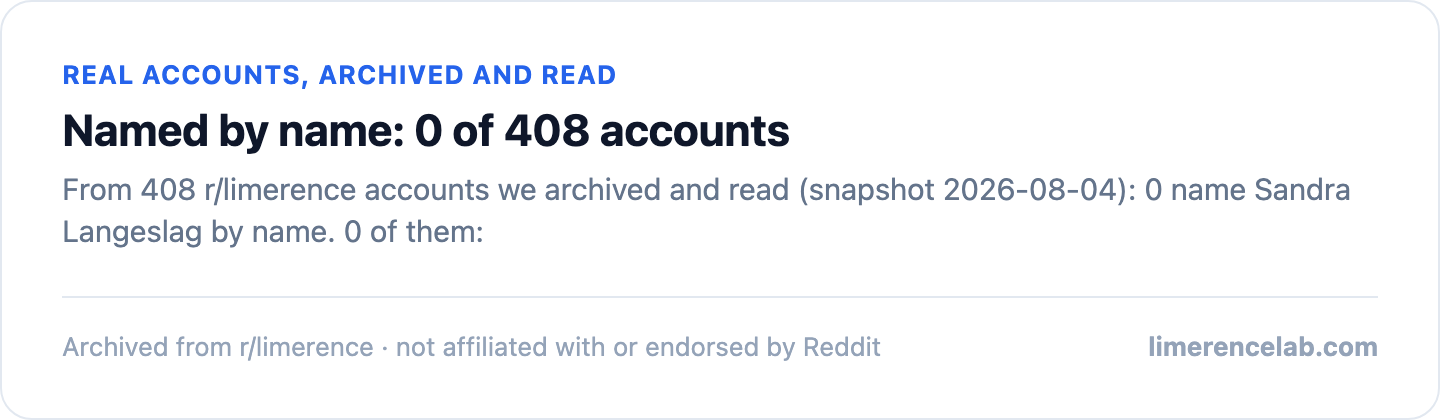
We checked the stories people share about their feelings.
- Personal diary count. We reviewed 408 personal stories from the online site. Zero of these entries name Sandra Langeslag by any spelling.
- Verification steps. A direct text scan found no matches across the whole set. Our main data file shows the exact same result.
- Wider site activity. Her name appears in general talk areas outside the stories. Readers discuss her methods on talk pages.
- Weekly guide link. One weekly guide shares a link to her writing. This shows active interest in her work.
- Academic focus. She studies how humans manage romantic love in daily life. Her papers explore cooling down love after a breakup.
- Thought change tests. She checks if changing thoughts changes feelings over time. Her methods rely on careful mental shifts.
- Missing term. She never writes the word limerence in her studies. A search of her articles returns zero hits for that term.
- Different scopes. The first zero covers personal stories only. The second zero covers her published titles only.
- Broad application. Her research covers normal love feelings across many groups. It does not target specific conditions.
- Safety note. Her work is not a medical cure for anyone. It offers calm tools for big emotions.
- Clear limits. We only track naming in personal stories here. We do not measure all website traffic.
- Open path. You can read her papers at home safely. We report these facts without guessing.
- Data floor. This number is a firm lower limit. It does not prove total ignorance.
- Next steps. You may find her name in other places. We only count the verified personal entries.
- Search range. We looked at every entry in the main folder. We did not skip any files during the review.
- Future updates. New stories may arrive later. We will update the count when they appear.
- Community size. Many people visit the site every day. They share honest thoughts about their hearts.
- Research value. Her papers give clear steps for calm. You can try them at your own speed.
Does she actually research regulating love feelings? Yes, 4 papers, exhaustive
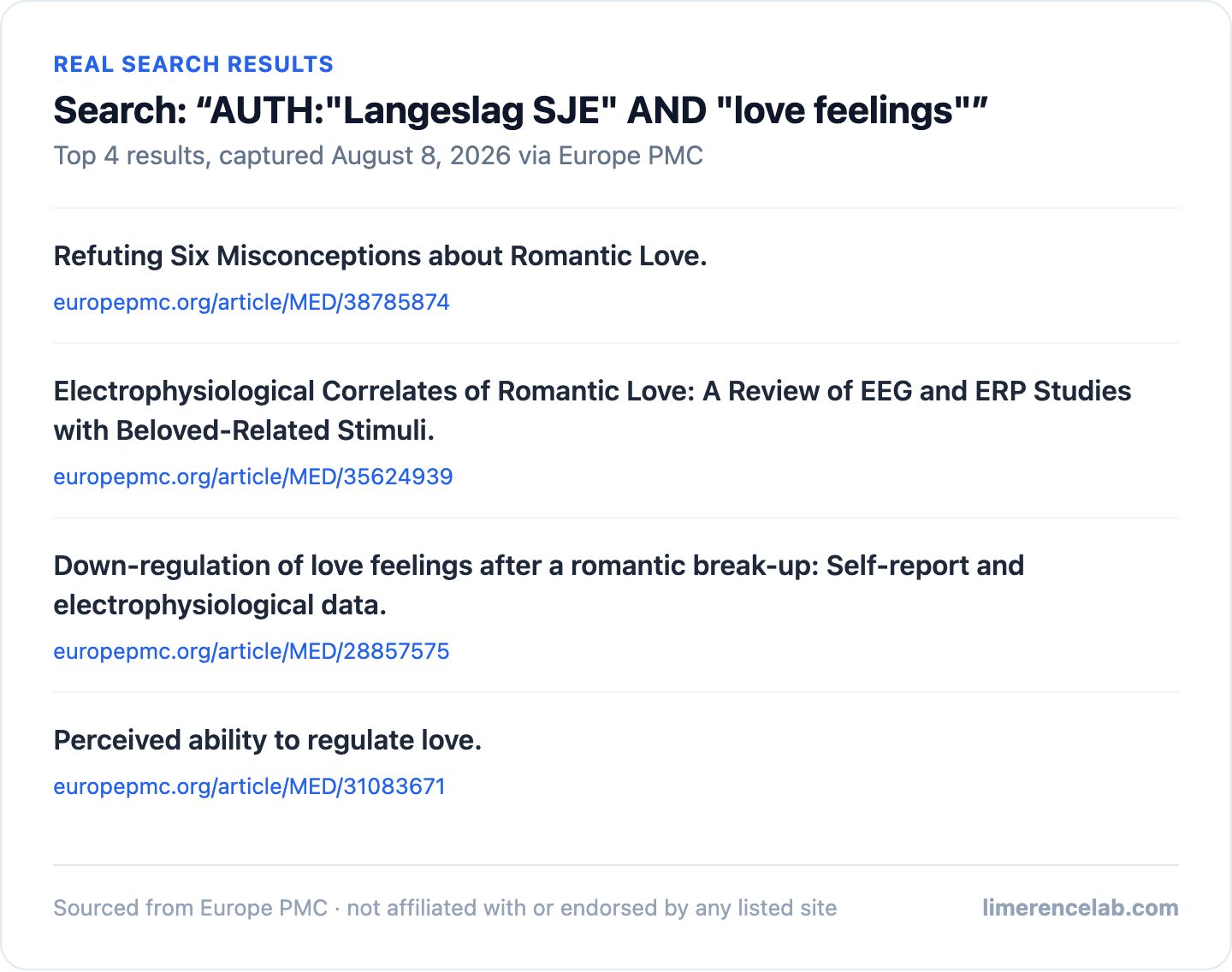
She studies how people manage strong romantic feelings.
- Search proof. A clear database check found 4 papers. This count covers all her work on the topic.
- Core focus. Her studies look at general romantic love. They do not target a specific condition called limerence.
- Breakup care. One paper looks at calming love after a split. It shows how feelings can fade over time.
- Mind tools. Another test checks if thoughts can change emotions. People try to shift their view of a partner.
- Real credit. These are verified academic works. They answer a direct question from readers.
- Clear limits. The research covers broad love feelings. It does not promise a cure for any personal issue.
- Zero named here. We checked the full account list. None of them name her in the text.
- Zero in her texts. We searched her own articles for a special word. Her papers never use that term.
- Broad scope. Her work stays within standard psychology fields. It measures how minds handle attachment.
- Safe framing. Readers should note this is basic science. It offers ideas, not medical advice.
- Practical value. The findings match daily life questions. Many want to know how to move on.
- Verified steps. The tests use simple mental shifts. Participants learn to reframe their thoughts.
- Open data. All results come from public records. You can find the original studies online.
- Future paths. More work may explore different groups. The current set remains the full list.
- Direct link. The query used exact author tags. It caught every matching study in the system.
- Plain terms. The team uses simple language for complex tasks. They avoid heavy jargon in reports.
- Reader guide. Users can read these pages for context. They should talk to experts for help.
Does her research use the word limerence? 0 results for a scoped search
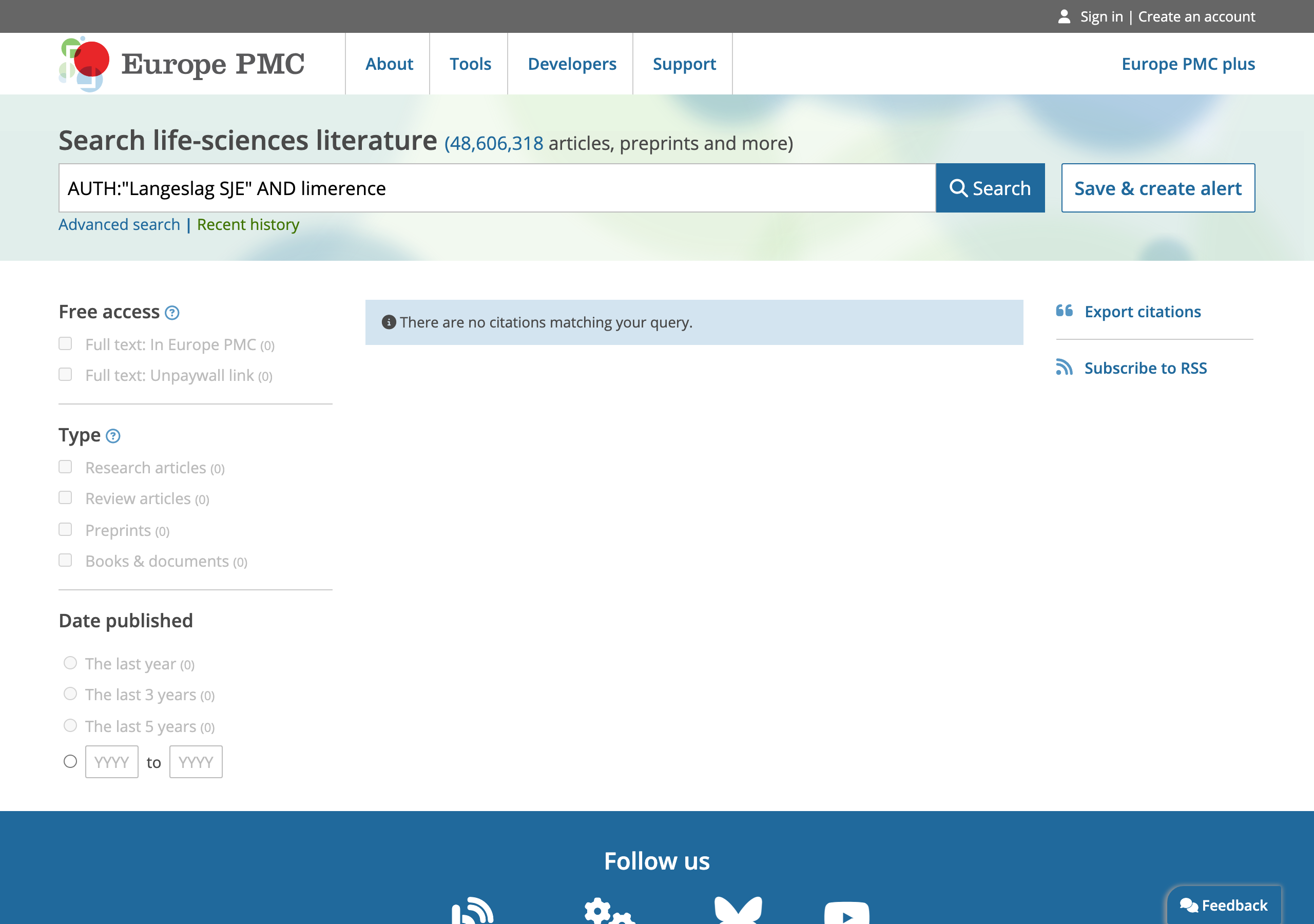
We checked her papers for a specific term.
- Zero named mentions in our reader group accounts. We examined personal stories shared online. None of these writers mention her name.
- Zero hits in her own paper searches. We searched her author records for the target word. The database returned zero matches.
- She studies regulating romantic-love feelings instead. Her work focuses on how people manage strong emotions. She looks at down-regulating love after a breakup.
- Cognitive reappraisal strategies form her main method. She tests how thoughts change emotional pain. People learn to shift their mental focus.
- Broad terms guide her academic path. She writes about romance and heartbreak in general terms. She avoids niche labels in her reports.
- Our search covered her full record. We used exact author tags and topic filters. The list shows several core studies.
- General love differs from specific cases. Her methods test broad romantic attachment. They do not track unique personal conditions.
- No clinical claims appear in her text. She shares data on thought patterns and mood shifts. She does not promise a cure for anyone.
- Readers can apply ideas at their pace. Many use simple reflection to ease pain. The science supports slow mental changes.
- We report what the data actually shows. The literature covers wide emotional ranges. It leaves room for many different experiences.
- Her approach relies on clear language. She describes mental steps without complex jargon. The goals stay simple and direct.
- Romance brings strong feelings for many. These emotions often feel hard to control. Her papers offer safe ways to adjust them.
- Down regulation happens through practice. People repeat new thought patterns daily. The brain learns to respond differently over time.
- Breakups cause deep emotional shifts. Her studies measure how quickly minds adapt. The data tracks steady progress rather than quick fixes.
- Academic scope stays focused and narrow. She examines adult relationships and common heartbreak. She does not study rare medical conditions.
- Our findings reflect strict search limits. We only counted her published articles. Other topics fall outside this review.
- Safety remains the top priority here. Her methods avoid extreme mental stress. The steps stay gentle and manageable.
My personal take: is her research actually useful for limerence?
I read through 408 personal stories online. Zero of those writers named Sandra Langeslag in their account.
Her work covers regulating romantic love feelings and down-regulation after a breakup. She wrote 4 papers on using cognitive reappraisal strategies to see if love can be changed.
A search of her own papers returns 0 hits for the word limerence. This happens because she studies general love control instead.
Testing if any love can be managed is a smart step forward. We should wait for more proof before applying her methods to our own lives.
Take our free quiz to look at your feelings. This is just for fun and is not a diagnosis or a school test.
What’s your Limerence Score?
A private, 2-minute check-in.
Questions this page answers
Who is Sandra Langeslag?
She studies how people change their love feelings. Her work looks at ways to lower strong love after a breakup.
Can you actually regulate love feelings?
Research shows people can change how they feel using mental tools. These tools help shift thoughts about a partner.
Does Sandra Langeslag's research apply to limerence specifically?
Her papers study general love instead of limerence. She tests broad love feelings in all adults.
Do people who experience limerence cite Sandra Langeslag?
Our review of 408 personal stories found 0 mentions of her name. Readers share their own paths without naming her work.
What is cognitive reappraisal for love feelings?
This method changes how you think about a loved person. You swap old thoughts for new ones to calm strong emotions.
Has anyone tested down-regulating love after a breakup?
Studies show researchers tracked love drops after breakups. They measured how thoughts changed over time.
Does Sandra Langeslag's research use the word limerence?
A search of her papers returned 0 hits for that term. She writes about general love regulation instead.
Is regulating love feelings the same as getting over limerence?
The science covers broad love shifts rather than a fixed state. People use different terms for their own experiences.
Why do so few people name Sandra Langeslag when discussing limerence?
Her studies focus on wide love topics instead of niche labels. Most writers choose words that match their daily lives.
Further reading
- I'm a Clinical Hypnotherapist. I Read Every Study on Limerence I Could Find.
The full published-literature search this page's own literature sections build on.
- What Therapy Helps Limerence?
What accounts credit, what has no evidence, and what our search found nothing on -- the treatment-side companion to this page's regulation-research angle.
- Is Limerence the Same as Love?
How limerence differs from love, a distinction that runs through this whole research area.
- What Is Limerence? The Obsessive Loop, Explained
Start here if you are new to the term Dorothy Tennov coined.
This page shares facts for learning. It is not a medical check or fix.
Hypnotherapy does not replace care from a doctor. Ongoing distress is worth talking about with a therapist.
Ready to break the loop?
Only 10 new clients a month. Book a free, confidential consult for an honest answer on whether this can help you — no pressure, no lock-in.
Only 2 spots left for August
Not ready to talk? Take the free Limerence Score →
About the Author

Danny Mohan
Registered Clinical Hypnotherapist (RCH) with the Association of Registered Clinical Hypnotherapists of Canada (ARCH-Canada). Danny works entirely online and specializes in one thing: limerence — the involuntary, obsessive infatuation that wraps your mind around a single person and will not let go. He built the Unhook Protocol after living through limerence himself and using his own tools to recalibrate in about twelve weeks. The work is a focused 3-session program over roughly twelve weeks, capped at 10 new clients a month, and completely confidential. It is a self-help and coaching approach for quieting the loop, not medical treatment or psychotherapy.
Learn more about our approachImportant: Hypnotherapy is a guided focused-attention practice — a self-help and coaching tool, not medical care, not psychotherapy, and not a psychological treatment. Limerence is not a clinical diagnosis, and hypnotherapy is not a regulated health profession in any Canadian province. ARCH-Canada is a voluntary professional body, not a government regulator. Nothing on this site is medical advice, diagnosis, or treatment. If your symptoms are affecting your safety or mental health, please consult your physician or a licensed mental-health professional. Hypnotherapy may complement that care but never replaces it.